NIOS Class 10 Economics Chapter 9: Demand explains the meaning of demand and the factors that influence the quantity demanded of a commodity. In this chapter, students will learn about the law of demand, its assumptions, individual and market demand, demand schedules and demand curves. The chapter also discusses the determinants of demand, normal and inferior goods, income effect, substitution effect and the law of diminishing marginal utility. These NIOS Class 10 Economics Chapter 9 solutions provide simple and clear answers to the Intext Questions and Terminal Exercises for better understanding and exam preparation.
NIOS Class 10 Economics Chapter – 9 Demand
MODULE 4: DISTRIBUTION OF GOODS AND SERVICES
TEXTBOOK QUESTIONS (SOLVED)
INTEXT QUESTIONS 9.1
Q.1. Define demand.
Ans. Demand may be defined as the quantity of a commodity that a buyer is willing to buy at a given price per unit of time.
Q.2. Name the three components included in the definition of demand.
Ans. Three components included in the definition of demand are as follows:
(i) Price of the commodity.
(ii) Quantity of the commodity to be bought.
(iii) The time period.
INTEXT QUESTIONS 9.2
Q.1. State the law of demand.
Ans. The law of demand states that other factors determining the demand remaining constant, price of a commodity and quantity demanded are inversely related.
Q.2. What are the assumptions of law of demand?
Ans. Following are the assumptions of law of demand:
(i) Income of the buyer does not change.
(ii) Price of related goods does not change.
(iii) Tastes, preferences and fashion do not change.
Q.3. What will happen to your demand for apples if price of apples rises from ₹ 80 per kg to ₹ 100 per kg, assuming that your income, taste, preferences etc.
Ans. Demand for apples will fall.
INTEXT QUESTIONS 9.3
Q.1. What will happen to the real income of the buyer if price of a commodity falls?
Ans. Real income will increase.
Q.2. What will be the shape of the demand curve when there is inverse relationship between price and its quantity demanded?
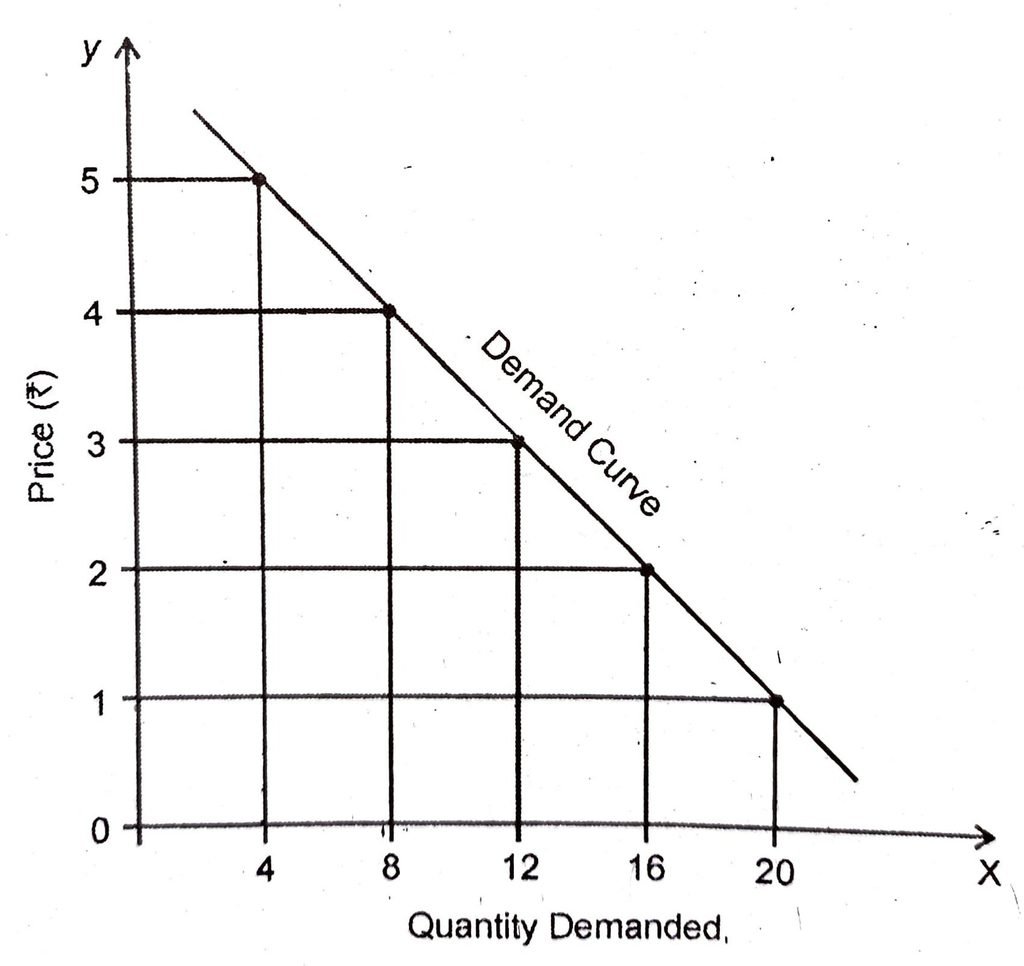
Ans. Demand curve will slop downwards from left to right.
Q.3. You are thirsty and you have already taken one glass of water. Whether the satisfaction derived from the second glass of water you drink, will increase or decrease?
Ans. Decrease.
Q.4. Draw a demand curve with the help of data given below:

Ans.
INTEXT QUESTIONS 9.4
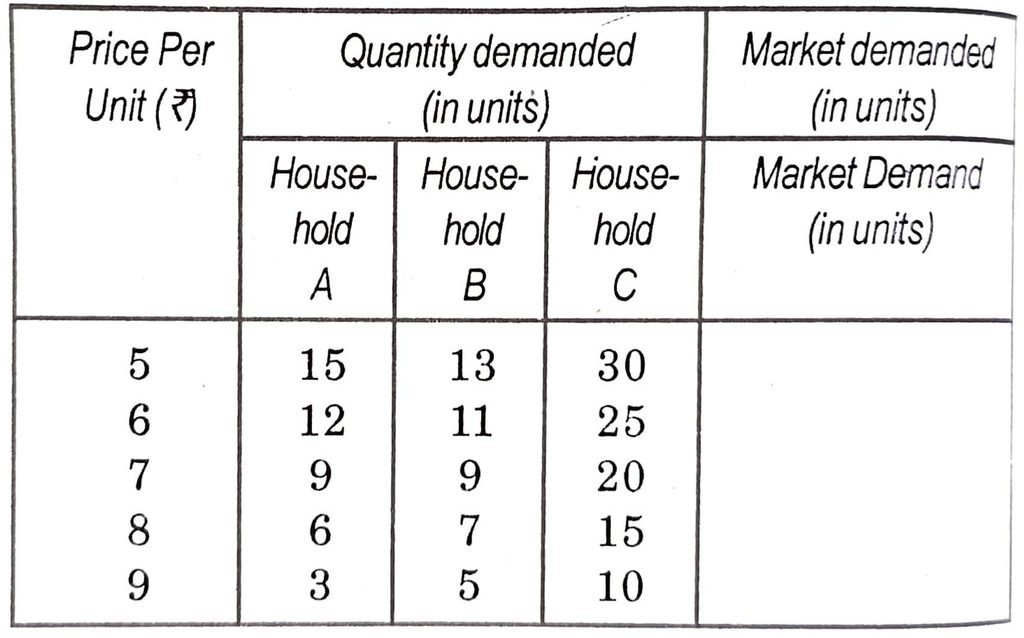
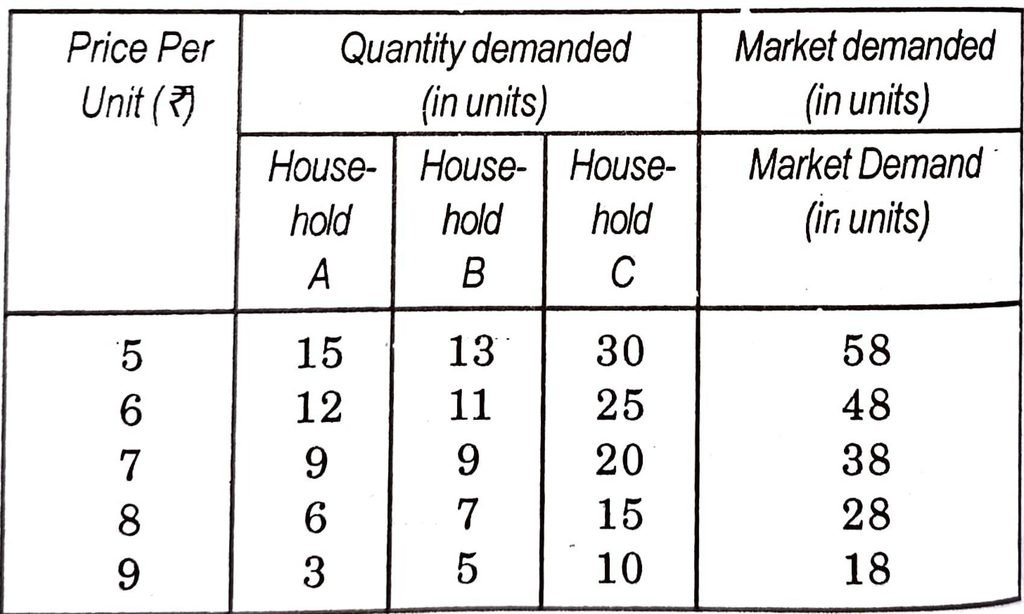
Q.1. If there are only three households buying a commodity in the market, calculate the market demand in the table given below:
Ans.
Q.2. Complete the following table:
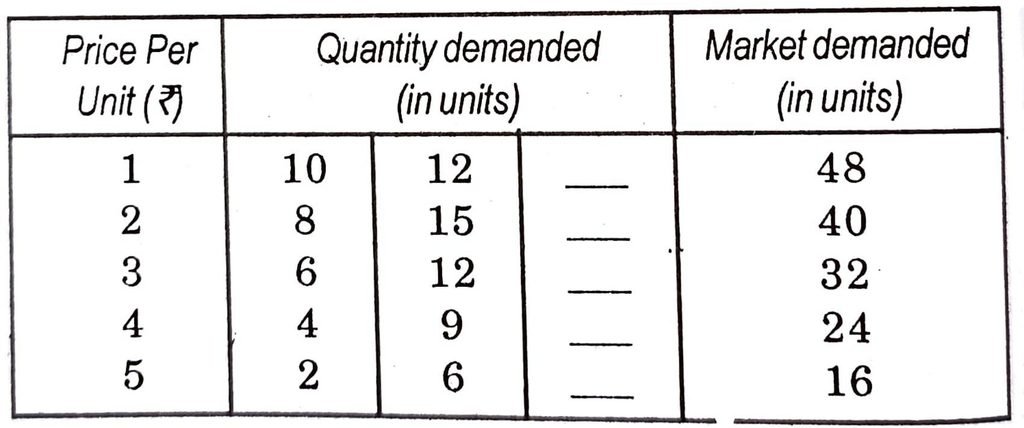
Ans.

INTEXT QUESTIONS 9.5
Q.1. Name four factors that affect the individual demand for a commodity.
Ans. Price of the commodity, price of related goods, income of the buyer, tastes, preferences and fashions.
Q.2. What will happen to the demand for tea if price of sugar increases?
Ans. Fall.
Q.3. What will happen to demand for Coke if price of Pepsi falls?
Ans. Fall.
Q.4. Distinguish between normal goods and inferior goods.
Ans. Demand for normal goods increases with the increase in income whereas demand for inferior goods decreases with the decrease in the income of the buyer.
Q.5. Prepare a list of at least five items which are in fashion now-a-days.
Ans. (i) Jeans.
(ii) Tops.
(iii) Electronic goods.
(iv) Watches.
(v) Ball-pens.
Q.6. Fill in the blanks with appropriate words:
(i) If the income of a buyer falls, his demand for inferior goods will _________.
Ans. Increase.
(ii) When price of ink increases, the demand for fountain pens will _________.
Ans. Decrease.
(iii) _________ is the number of buyers of a commodity in the market, higher will be the demand for the commodity.
Ans. More.
(iv) If the distribution of income and wealth is more in favour of the _________ the demand for goods used by the poor will be more.
Ans. Poor.
TERMINAL EXERCISE
Q.1. Define demand. Distinguish between individual demand and market demand.
Ans. Individual demand is the quantity of a commodity that an individual buyer is willing to buy at the given price at given time.
On the other hand, market demand is the total quantity of demand that all the individual buyers in the market are willing to buy at a given time.
Q.2. Briefly explain the determinants of individual demand for a commodity.
Ans. Factors determining the Demand for a Commodity: Following factors determine the demand for a commodity:
(i) Price of the Commodity: There is inverse relationship between the price of a commodity and its demand if other things remaining same. When the price of the commodity falls, its demand rises and vice versa.
(ii) Prices of related Goods: Related goods are of two types:
(a) Substitute goods. and
(b) Complementary goods.
Substitute goods are those goods which can be used in place of another whereas complementary goods are those goods which are used together to satisfy a want. There exists a direct positive relationship between the price and demand for substitute goods (tea and coffee) as shown in the diagram.

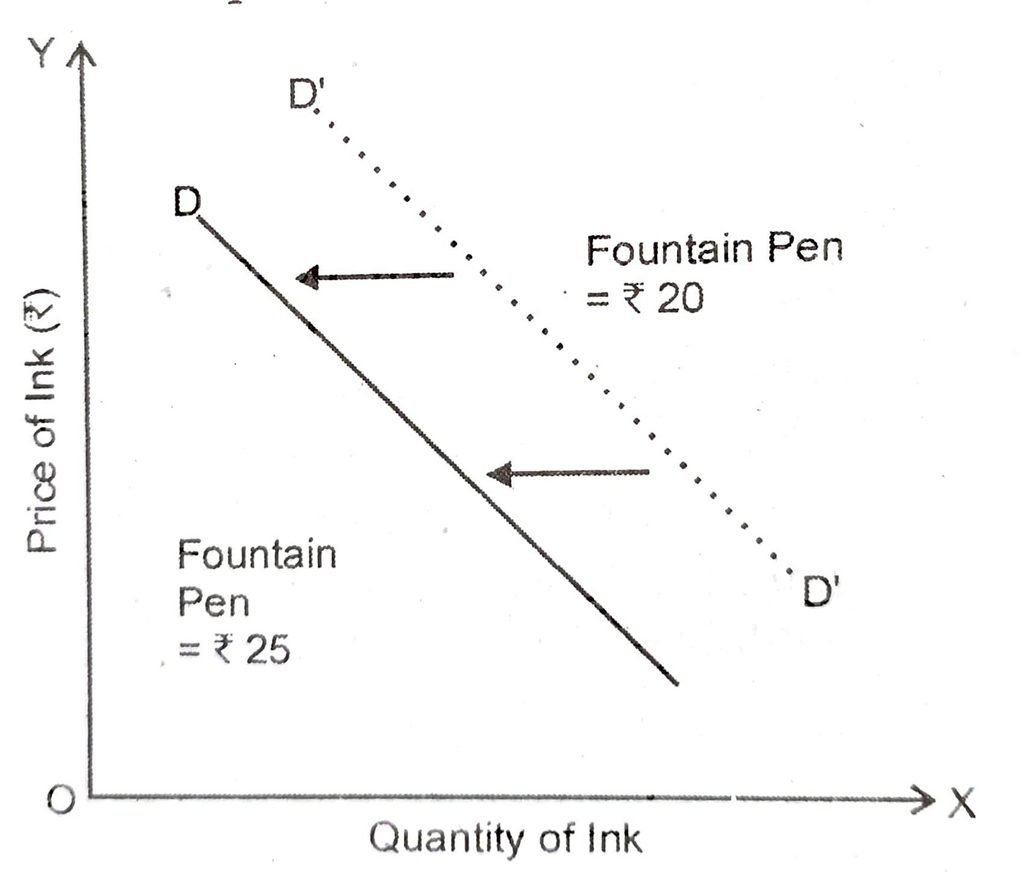
On the other hand there is a negative or reverse relationship between the price and demand of complementary goods. For example, we take pen and ink as complementary goods. If the price of pen increases, its demand will fall resulting into the fall in the demand of ink as it is used with it. It has been shown with the help of the diagram.
(iii) Income of the Consumers: There is direct relationship between the income and demand for normal goods, i.e. demand for normal goods increases with the increase in income and vice versa. In case of inferior goods, there is inverse relationship between the income and demand for goods. The demand for inferior goods fall with increase in income and vice versa.
(iv) Taste: Taste also affects the demand for a commodity. Favourable change in taste causes increase in demand and the demand curve shifts rightwards. But if there is unfavourable change in the taste, then the demand will fall and the demand curve will shift to the left.
Q.3. State the factors which may affect market demand for a commodity.
Ans. Following factors may affect market demand for a commodity:
(i) Number of buyers.
(ii) Distribution of income and wealth.
(iii) Climatic conditions.
Q.4. State and explain the law of demand with the help of a hypothetical numerical example/schedule.
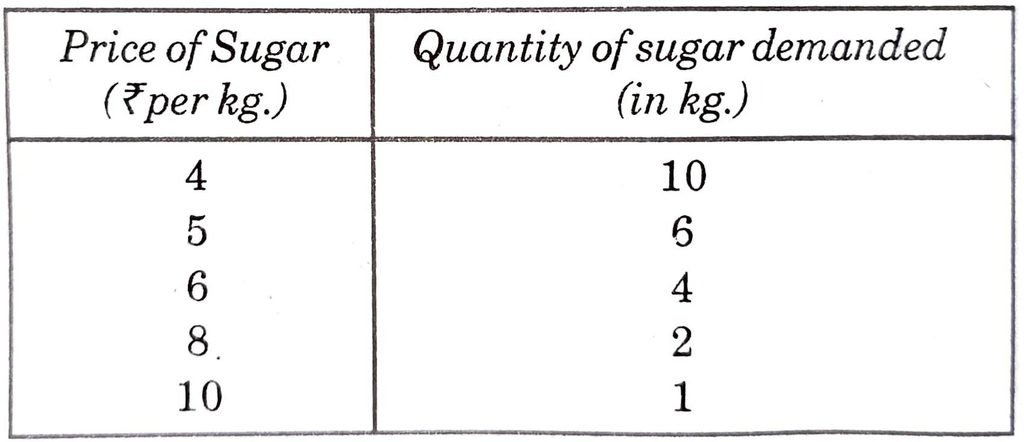
Ans. Law of Demand: Law of demand states that the quantity demanded varies inversely with its price, other determinants remaining unchanged. This law explains the functional relationship between the quantity demanded and price. Prof. Marshall has defined it as “If other things remaining same, the amount demanded increase with a fall in price and diminishes with a rise in price”. Hence there exits inverse relationship between the price and quantity demanded. This law can be explained with the help of the following demand schedule:
Q.5. What is a demand curve? Draw an individual demand curve with the help of a hypothetical demand schedule.
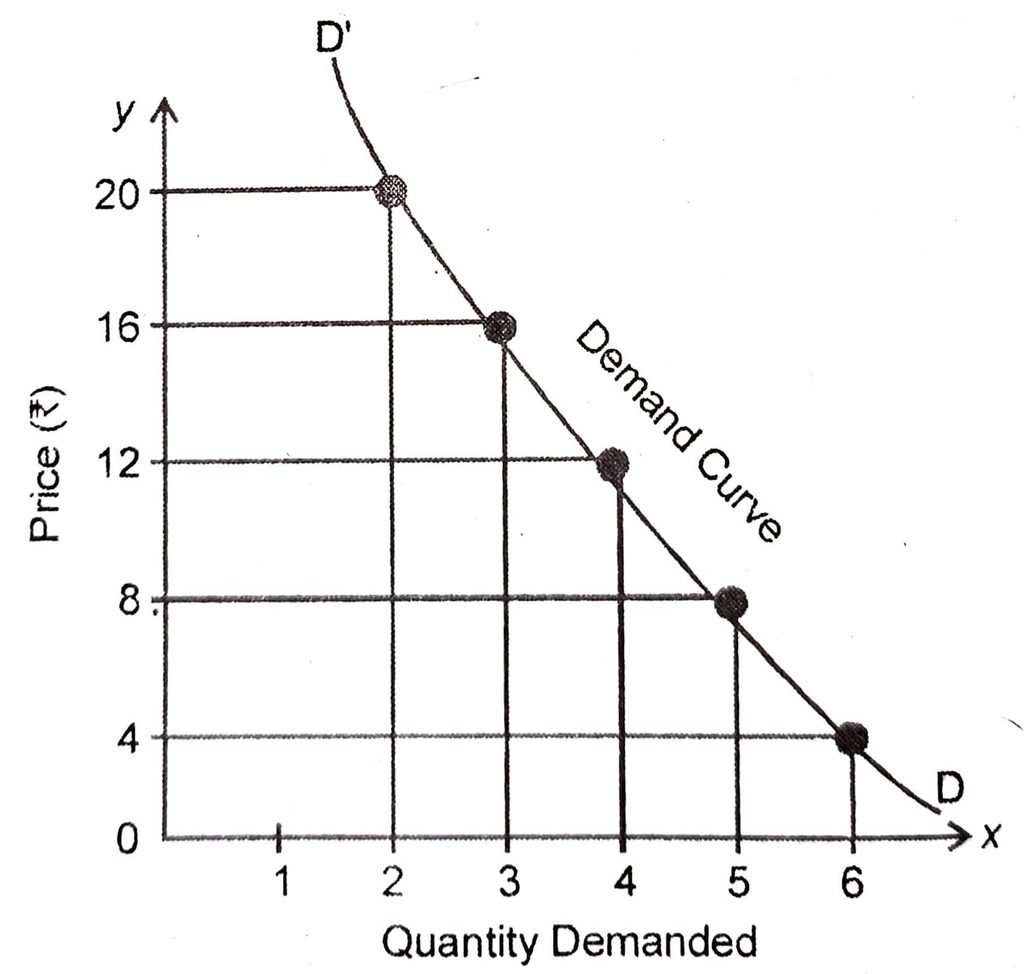
Ans. Demand Curve: Demand curve is a diagrammatic representation of law of demand. It slops downward from left to right.

Drawing an individual demand curve with the help of above demand schedule:
Q.6. Why does the demand curve slope downwards from left to right?
Ans. Demand curve slops downwards due to following reasons:
(i) Law of Diminishing Marginal Utility: According to this law, as the consumption of commodity increases, the utility from each successive unit goes on diminishing to a consumer. For example, a hungry person gets maximum satisfaction from the first chapatti, lesser satisfaction from second chapatti and still lesser from third chapatti and so on. If he gets more satisfaction, he will be ready to pay more and if he gets less satisfaction, he will be ready to pay less price it. It means he will be willing to buy more quantity of a commodity at lower price and less of it at higher price. The law of demand also provides the same information which will lead to downward slope of a demand curve.
(ii) Income Effect: Income effect refers to change in quantity demanded when real income of the buyer changes as a result of change in price of a commodity. Change in the price of a commodity causes a change in real income of the consumer. With a fall in price, real income increases. Accordingly demand for the commodity expands. For example, you buy mangoes from the market. the price mangoes is ₹ 40 per kg. and you buy 2 kgs of mangoes at this price. If the price of mangoes falls from ₹ 40 per kg. to ₹ 20 per kg., your real income or purchasing power is doubled and you can now buy double quantity i.e. 4 kg. of mangoes with the same money. Thus a buyer can buy more quantity of a commodity when its price falls and-less when its price rises leading to the downward slop of the demand curve.
(iii) Substitution Effect: Substituting a cheaper commodity for the relatively expensive commodity is called substitution effect. Alternatively it refers to the substitution of one commodity in place of the other commodity, when it becomes relatively cheaper. For example if the price of Coke falls, it becomes relatively cheaper than its substitute i.e. Pepsi. People start buying Coke in of Coke (Alternatively Pepsi is substituted by Coke), leading to more demand for Coke when its price falls. On the other hand, demand for the commodity will fall when its price rises. It will lead to downward slope of the demand curve.
Q.7. What is the reason behind the law of demand?
Ans. Reason behind the Law of Demand: Reason behind the law of demand is the law of diminishing marginal utility. According to this law. As gas more and more units of a commodity are consumed, marginal utility derived from each successive. unit goes on falling. In other words, as a person consumes more (or additional) units of a commodity the extra utility (i.e. marginal utility) derived from each successive unit goes on falling because the desire for that commodity tends to fall.
Conclusion
The NIOS Class 10 Economics Chapter 9 “Demand” helps students understand how the price of a commodity and other factors influence its demand. The chapter explains the law of demand, demand curves, individual and market demand, and the major determinants of demand such as income, prices of related goods, taste and the number of buyers. These solved questions will help NIOS students revise important concepts, understand the relationship between price and demand and prepare effectively for their examinations.