NIOS Class 10 Economics Chapter 7: Production explains the meaning and process of production and the role of inputs in producing goods and services. In this chapter, students will learn about inputs, output, production function, labour-intensive and capital-intensive technology, division of labour, marginal product and the law of diminishing marginal product. The chapter also covers firms, industries and different types of production units. These NIOS Class 10 Economics Chapter 7 solutions provide simple and clear answers to the Intext Questions and Terminal Exercises for better understanding and exam preparation.
NIOS Class 10 Economics Chapter – 7 Production
MODULE 3: PRODUCING GOODS AND SERVICES
TEXTBOOK QUESTIONS (SOLVED)
INTEXT QUESTIONS 7.1
Q.1. Define inputs.
Ans. Inputs may be defined as the resources which are used in the production.
Q.2. Define output.
Ans. The and services produced by using inputs are called output.
Q.3. Define production function.
Ans. Production function is determined as the technical relationship between inputs and output of a firm.
INTEXT QUESTIONS 7.2
Q.1. Define labour-intensive technology.
Ans. More use of labour and less use of capital per unit of output in the production of a commodity is called labour-intensive technology.
Q.2. Define capital-intensive technology.
Ans. More use of capital and less use of labour in production of a commodity is called capital-intensive technique of production.
Q. 3. Give one example each of product based and process-based division of labour.
Ans. (i) Product-based Division of Labour: Pot making.
(ii) Process-based Division of Labour: Bread manufacturing.
INTEXT QUESTIONS 7.3
Q.1. Define marginal product.
Ans. Marginal productivity may be defined as increase or decrease in total product resulted due to change in one unit of labour, keeping all other inputs unchanged.
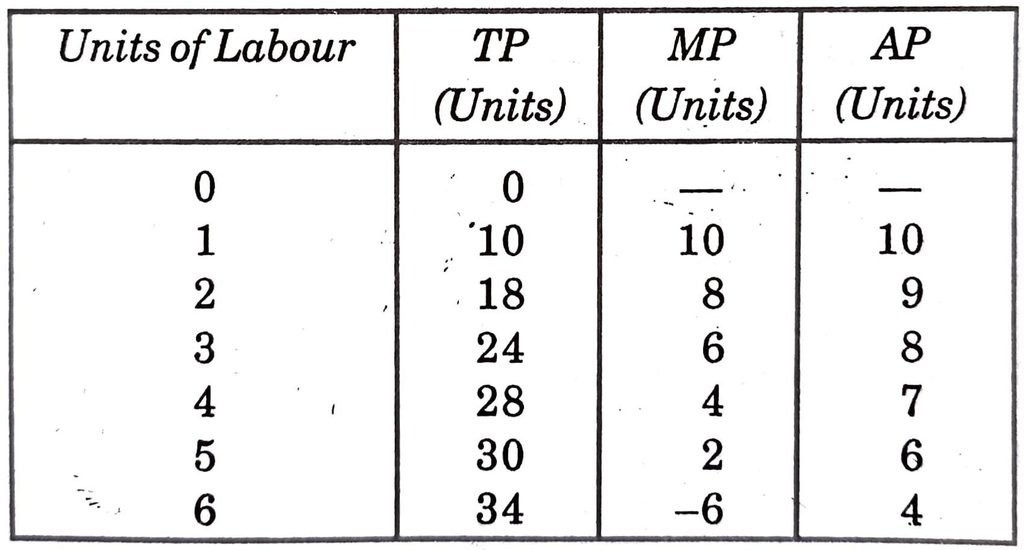
Q.2. Calculate MP and AP with the help of following table:

Ans.
INTEXT QUESTIONS 7.4
Q.1. State the law of diminishing marginal product?
Ans. According to the law of diminishing marginal product with continuous increase in variable factor, marginal product will increase initially, till certain point is reached, but after that it will decrease and may become negative, keeping all other factors unchanged.
Q.2. What is the level of total product when marginal product is minimum?
Ans. Total product is maximum.
Q.3. When the producer should stop employing more labour?
Ans. When marginal product becomes negative.
INTEXT QUESTIONS 7.5
Q.1. Define production process.
Ans. The process of procuring inputs, utilising their services and producing goods and services is called production process.
Q.2. Who organises the productive activity?
Ans. Entrepreneur.
INTEXT QUESTIONS 7.6
Q.1. What is a firm?
Ans. A firm is any individual production unit of a commodity.
Q.2. Give the meaning of industry.
Ans. Industry is a group of all the firms making production of an identical commodity.
INTEXT QUESTIONS 7.7
Tick mark (✓) the correct answer:
Q.1. A production unit owned by a single individual is known as:
(a) A partnership.
(b) A private company.
(c) Sole proprietorship.
(d) A public production.
Ans. (c) Sole proprietorship.
Q. 2. In a partnership the maximum number of partners is:
(a) 5
(b) 10
(c) 15
(d) 20
Ans. (d) 20
Q.3. Indian Railways is a:
(a) Private Unit.
(b) Public Unit.
(c) Sole Proprietorship.
(d) Partnership.
Ans. (b) Public Unit.
Q.4. Minimum number of members in a cooperative society is:
(a) 20
(b) 13
(c) 10
(d) 5
Ans. (c) 10
Q.5. Maximum number of share-holders in a public company is:
(a) 10,000
(b) 15,000
(c) 20,000
(d) No limit
Ans. (d) No limit.
Q.6. A Govt. production unit registered under Companies Act, 1956 is a:
(a) A Statutory Corporation.
(b) Government Company.
(c) Departmental Enterprise.
(d) None of these.
Ans. (b) Government Company.
Q.7. The minimum number of owners in a private company is:
(a) 7
(b) 10
(c) 2
(d) 20
Ans. (c) 2
Q.8. In which situation a production unit is not considered as a foreign production unit:
(a) Entire capital is invested by non- resident.
(b) More than 50% of the total capital is invested by non-residents.
(c) Residents have more than 50% of the total product.
(d) Less than 20% of the investment is made by residents.
Ans. (c) Residents have more than 50% of the total product.
TERMINAL EXERCISE
Q.1. Define Production Process.
Ans. Production process may be defined as the process of combining inputs, utilising their services and making production of goods and services.
Q.2. How does an entrepreneur organise a product unit?
Ans. An entrepreneur organise a product unit by continuing the various factors of production in right proportion.
Q.3. Distinguish between labour-intensive and capital-intensive technology of production.
Ans. Capital-intensive Method: Capital intensive technology of production is that technology of production in which we make more use of capital and less use of labour per unit of output in the production of our commodity.
Labour-intensive Method: When a production unit uses more labour, capital per unit of output then it is called labour, intensive method of production. For example, basket, rope, and mats making, canning of chairs, wood carving, embroidery works etc. involve more use of labour and less of capital. This method of production used in making these things is called labour-intensive.
Q.4. Distinguish between product-based and process-based division of labour.
Ans. In product-based division of labour, a worker specialises in the production of a single good or service. This type of division of labour is used in case of small farmers, a potter, a cobbler or a carpenter in a village. It is also used in the production for self- consumption or on a small scale.
On the other hand, process-based division of labour is used in big production units like corporations and government enterprises where production is made on a very large scale. In this type of division of labour, the production of a commodity is divided into many processes and a worker specialises in one or two processes.
Q.5. Distinguish between indigenous induction units and foreign production units.
Ans. Distinction between an indigenous unit and a foreign production unit are as under:
Indigenous Production Unit: The production units located in country and owned by the residents of the country are indigenous production units. Example-Small factory, government offices, ration shops, schools etc.
Foreign Production Unit: The production units owned by non-residents of the country are termed as foreign production unit. In a foreign production unit at least 50 per cent capital is invested by non-residents.
Q.6. Distinguish between private sector and public sector production units.
Ans. Private production units are owned by private persons and institutions whereas public sector units are owned by government. Private production units produce goods and services for sale in the market with the aim of earning profit whereas, public sector production units provide a lot of services such as education, health care, law and order, post and telegraph, transport, telecommunication and broadcasting etc.
Q. 7. Distinguish between sole proprietorship and partnership.
Ans. Sole Proprietorship: A production unit is owned by a single person is termed as a sole proprietorship. He is responsible for the management of the unit and pockets all the profits and bears all the loss by the unit.
Partnership: A production unit owned by two or more persons simultaneously is termed as partnership. In such unit all partners are collectively responsible for the management of the unit. They share the profit and bear the loss in the ratio agreed upon at the time of forming the partnership.
Q.8. Distinguish between a company and a cooperative society.
Ans. Difference between a Company and a Cooperative Society.
| Company | Cooperative Society |
| (i) It is suitable for large, scale business organisations. | (i) It is suitable for small-scale and medium size business. |
| (ii) It is established under Companies Act, 1956. | (ii) It works according to Cooperative Societies Act, 1912. |
| (iii) Formation of a company is the complicated. | (iii) Formation of a cooperative society is easy. |
| (iv) It has unlimited resources. | (iv) It has limited resources. |
Q.9. Distinguish between departmental and non-departmental enterprises.
Ans. Departmental Enterprises: Government enterprises which are under the direct control of some government department or ministry are termed as departmental enterprises. Either Parliament or State Legislative Assembly had direct control over their functioning. The minister for the concerned ministry is responsible for the functioning of such an enterprise. Example- Indian Railways, All India Radio, Doordarshan etc.
Non-Departmental Enterprises: Those enterprises whose legal existence is separated from that of government, are termed as non-departmental enterprises. These are autonomous in nature and Parliament or State Legislative Assembly has no direct control over their functioning.
Example: UTI, Indian Airlines, HMT, Indian Telephone Industries Ltd. etc.
Q.10. Distinguish between autonomous corporation and government companies.
Ans. Difference between Autonomous Corporation and Government Companies: Autonomous corporations are government production units which are supported and funded by the government, but function independently. They are non-departmental enterprises and called public sector undertakings. On the other hand government companies are those government production units which are generally under direct control of the ministry.
Q.11. Distinguish between multinational and collaboration.
Ans. Multinational Firm: A firm which has its main office in one country but has its business activities spread in many other countries is termed as a multinational firm.
Collaboration: It is a foreign production unit operates in a country. In this firm foreign entrepreneurs and domestic entrepreneurs jointly participate in production unit. In such unit to be treated as a collaboration more than 50% of the capital must be invested by non-residents.
Q.12. Distinguish between firm and industry.
Ans. Firm is a production unit which makes production of goods and services for sale in the market in order to earn profit.
On the other hand industry is a group of all the firms making production of similar commodity.
We can differentiate between a firm and a by taking an example. Bata Shoe Company is a firm which makes shoes but the shoe industry includes all the firms producing shoes. So Bata, Action, Liberty, Adidas, Nike, Reebok etc. firm the shoe-industry.
Q.13. Explain the role and importance of firms and industries.
Ans. The Role and Importance of Firms and Industries: The role and importance of firms and industries has been explained below:
(i) Production of Goods and Services for Consumption: The firms and industries produce various types of goods and services for satisfying the human wants. The human satisfies its needs by consuming the goods and services produced by firms and industries.
(ii) Production for investment: They produce goods like machines, plants, transport vehicles (like buses, trucks, railways, ships, aeroplanes etc.) and other various goods for investment.
(iii) Providing Employment: Firms and industries are the sources of employment to people. By employment, people get income for the satisfaction of their wants.
(iv) Provide Infrastructure for the Development of the Country: They provide energy, transport, communication, health, education and housing which is the basic requirement to provide infrastructure for the country. Without the development of infrastructure, the all round development of the country is not possible.
Conclusion
The NIOS Class 10 Economics Chapter 7 “Production” helps students understand how inputs are combined and used to produce goods and services. It explains important concepts such as production technology, division of labour, marginal product, firms and industries, along with different forms of production units. The solved Intext Questions and Terminal Exercises will help NIOS students revise the key concepts, understand the production process and prepare effectively for their examinations.