NIOS Class 10 Economics Chapter 6: Basic Economic Activities explains the three major economic activities of an economy—production, consumption and capital formation. In this chapter, students will learn about the factors of production, including land, labour, capital and entrepreneurship, along with the role of resources in production. The chapter also explains durable and non-durable goods, services, productivity and capital formation. These NIOS Class 10 Economics Chapter 6 solutions provide simple and clear answers to the Intext Questions and Terminal Exercises for better understanding and exam preparation.
NIOS Class 10 Economics Chapter – 6 Basic Economic Activities
MODULE 2: ABOUT ECONOMY
TEXTBOOK QUESTIONS (SOLVED)
INTEXT QUESTIONS 6.1
Q.1. Below is a list of some of the factors that are used to produce shorts. Group them into natural resources, human resources, fixed capital and working capital.
| Yarn, machinery, land for factory, wooden doors, colour, dye, building, sewing machine, telephones, marketing managers, advertising managers, packaging machines, scissors, buttons, bank loans, cash money. |
Ans.
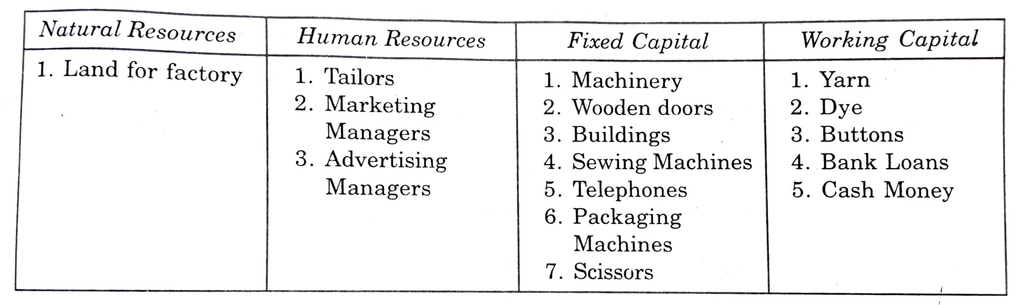
Q.2. Which of the following is not a characteristics of land:
(a) Mobile.
(b) Gift of Nature.
(c) Limited in Quantity.
(d) Indestructible.
Ans. (a) Mobile is not the characteristic of land.
INTEXT QUESTIONS 6.2
Ram Singh a farmer in a village of Haryana who owns 2 hectares of land. Both he and his wife Rani work in the field. Earlier they only grew paddy on their land. Now they want to increase the productivity of their land by growing two crops and better variety of seeds and irrigation. They want to grow two crops, paddy and potatoes. For this they need money to buy good quality of seeds and fertilizers. As they do not have enough money, both work in other’s farms as labourers. They spend some money on fertilizers, seeds, pumpsets etc. After working very hard, they manage to have a good crop of both paddy and potato. They keep some paddy and potato grown in their farm for their personal use and sell the rest. They earn ₹ 12,000 by selling their crops.
(i) Identify the factors of production in this story.
(ii) What are capital goods used in this example?
Ans. (i) Factors of production in the story are as follows:
(a) Land.
(b) Labour.
(c) Capital. and
(d) Entrepreneur.
(ii) Fertilizer, seeds and pumps are capital goods.
INTEXT QUESTIONS 6.3
Q.1. Give two examples of durable goods, non-durable goods and services.
Ans. (i) Durable Goods:
(i) Television. and
(ii) Refrigerator.
(ii) Non-durable Goods:
(i) Bread. and
(ii) Butter.
(iii) Services:
(i) Services of a teacher.and
(ii) Services of a doctor.
Q.2. There is an excess of production over consumption in a year. Where does it go?
Ans. It goes to capital formation.
Q.3. How does production facilitate and capital formation?
Ans. An increase in production of goods and services increases the level of consumption and capital formation. More consumption is possible only when there is. more production and capital formation is possible only when production is more than consumption.
TERMINAL EXERCISE
Q.1. An agricultural land is a fixed resource. How can its productivity be increased?
Ans. The productivity of land can be increased by better irrigation facilities and machines.
Q.2. How can the productivity of labour be increased?
Ans. Productivity of labour can be increased through education and training.
Q.3. What are main functions of an entrepreneur?
Ans. Following are main functions of an entrepreneur:
(i) He initiates to start the process of production of goods or services by bringing land, labour and capital together in right proportion.
(ii) He bears the risks and uncertainties involved in the production.
(iii) He makes the payments to other factors of production in the form of interest, wages and rent.
(iv) He makes arrangement.
Q.4. How does capital add to the productivity of labour?
Ans. Capital adds to the productivity of labour by making him skillful through education and training.
Q.5. If there is an excess of production over consumption in a year, where does it go? Also mention two things which help in capital formation in an economy.
Ans. Excess of production over consumption goes to capital formation.
(i) Saving. and
(ii) Investment of savings in capital goods.
Q.6. Mention the three important economic activities and show their inter- relationship diagramatically.
Ans. Three important economic activities are as follows:
(i) Production.
(ii) Consumption. and
(iii) Capital formation.

Q.7. Purchase of a cycle by a household is treated as:
(a) Capital formation.
(b) Production by households.
(c) Consumption.
(d) Production for self-consumption.
Ans. (c) Consumption.
Q.8. Which of the following statements are true or false?
(a) Capital formation increases the capital of a country.
Ans. True.
(b) Growing vegetable in the kitchen garden is not a part of production.
Ans. False.
(c) A farmer producing wheat for self-consumption is a part of production.
Ans. True.
(d) A teacher teaching school is production.
Ans. True.
(e) A student using stationery is production.
Ans. False.
(f) Digging a well by members of a family in their own field is a part of capital formation.
Ans. True.
(g) A truck transporting wheat from a village to the market in the nearby town is a part of production.
Ans. True.
Q. 9. Fill in the blanks:
(a) Roads constructed by the government are ________ (Production/Capital formation).
Ans. Production.
(b) Purchase of a tractor is a part of ________ (Production/Consumption).
Ans. Production.
(c) A new house purchased by an individual is ________ (Consumption/Production).
Ans. Production.
(d) A doctor is seeing a patient is ________ (Production/Consumption).
Ans. Production.
(e) A student studying in a school is ________ (Production/Consumption).
Ans. Production.
Conclusion
The NIOS Class 10 Economics Chapter 6 “Basic Economic Activities” helps students understand how production, consumption and capital formation are connected with one another. The chapter explains the factors of production, productivity of land and labour, the functions of an entrepreneur and the importance of saving and investment in capital formation. These solved questions will help NIOS students revise important concepts, understand basic economic activities and prepare effectively for their examinations.