NIOS Class 12 Economics Chapter 20 – Price Elasticity of Supply explains how much the quantity supplied of a commodity responds to a change in its price. This chapter covers important concepts such as elastic supply, inelastic supply, perfectly elastic supply, perfectly inelastic supply and unitary elastic supply. Students will learn how to calculate price elasticity of supply using the percentage method and understand the geometric method of measurement with the help of supply curves. The chapter also explains the factors affecting elasticity of supply, including the nature of the commodity, cost of production, availability of resources, production facilities and time period. It includes numerical problems to help students practise elasticity calculations. In this article, NIOS Class 12 Economics Chapter 20 textbook questions and answers are explained in simple language to help students understand the concepts and prepare effectively for their examinations.
NIOS Class 12 Economics Chapter – 20 Price Elasticity of Supply
Module – VII: Producer’s Behaviour
TEXT-BOOK QUESTIONS WITH ANSWERS
INTEXT QUESTIONS 20.1
Q.1. Define price elasticity of supply.
Ans. Price elasticity of supply measures the degree of responsiveness of quantity supplied of a commodity to change in its price. But the problem is that all the commodities do not respond in the same way to change in price. Some commodities are more responsive to change in price than others. For example, if the price of a commodity increases by 20 percent and it quantity supplied increase by 40 percent. In this case the supply of the commodity is very elastic because percentage in quantity supplied of the commodity is double the percentage change in its price.
Q.2. What is the co-efficient of perfectly elastic supply.
Ans. The elasticity is represented in numerical form, and is defined as the percentage change in the quantity supplied divided by the percentage change in price. When the coefficient is less than one, the supply of the good can be described as inelastic when the coefficient is greater than one, the supply can be described as elastic. An elasticity of zero indicates that quantity supplied does not respond to a price change: it is “fixed” in supply. Such goods often have no labour component or are not produced, limiting the short run prospects of expansion. If the’ coefficient is exactly one, the good is said to be unitary elastic.
Q.3. What is the main feature of unitary price elasticity of supply.
Ans. When the percentage change in quantity supplied of a commodity is equal to percentage change in its price, the supply of the commodity is said to be unitary elastic. It means if the price of the commodity increases by 50 per cent its quantity supplied will also increase by 50 percent. It can be explained with the help of the following supply schedule and supply curve.
Q.4. What is price elasticity of supply if the supply curve cut y-axis at a point above the point origin.
Ans. First up is perfectly elastic supply, which means an in infinitesimally small change in price results in an infinitely large change in quantity supplied. The coefficient of elasticity for this alternative is E = “. A click of the button reveals a perfectly elastic supply curve, which is horizontal and intersects the vertical price axis.
When we looked at the diagrams illustrating the elasticity of demand curves, the key point was how steep or flat the curve was (although it must be appreciated that the elasticity did change as one moved along the demand curve). With supply curves, the issue is not so much the gradient of the curve but whether it cuts the x – axis, the y – axis or the origin.

In the fig. S, is quite a flat curve but S₂ is fairly steep. But the gradient is not the issue. Both curves have an elasticity of less than one because they both cut the x-axis. The percentage change in quantity supplied has to be higher than the percentage change in price because one is working out the percentage change in quantity supplied from a higher initial figure.
You might expect the flatter curve to be relatively elastic. Looking at the move from point A to point B in the diagram, if the price rises from 1 to 2 (a 100% increase) this causes quantity supplied to rise from 10 to 12 (a 20% rise). This gives an elasticity of + 0.2 (20 divided by 100), which is very inelastic.
Q.5. What is price elasticity of specify if the supply curve cuts x-axis in the positive range.
Ans. In the context of economic policies, the time between a shock to the economy and realization that the shock has occurred. This is one of several policy lags that limit the effectiveness of stabilization policies designed to correct business-cycle fluctuations. This is also one of two inside lags. The other is an implementation lag also termed identification lag, the recognition lag emerges due to the time needed to measure economic activity. While the lag is generally positive, it actually can be negative through accurate forecasting techniques. When negative policies can be undertaken to correct a problem before it occurs.
Q.6. Define perfectly price inelastic supply.
Ans. Supply of a commodity is said to be perfectly inelastic when the quantity supplied of a commodity does not change at all in response to change in price of the commodity. It means that the price of the commodity may increase or decrease but its quantity supplied remained the same. In such cases the price elasticity of supply is zero and supply curve is a vertical line parallel to y-axis.
INTEXT QUESTIONS 20.2
Q.1. When the price of a commodity increases by 20%, its supply increases by 30%. What is the price elasticity of supply?
Ans. Price increases = 20%
Supply increases = 30%
Price elasticity of supply = Supply increase/ Price increase
Eₛ = 30/20 = 3/2 = 1.5
Q.2. At a price of ₹ 100 per unit, a seller supplies 300 units of a commodity. Calculate price elasticity of supply if he supplies 450 units of the commodity at a price of ₹ 200 per unit.
Ans. Eₛ = % change in quantity supplied/ % change in price

Q.3. A seller supplies 100 unit of a commodity at a price of ₹ 40 per unit. How much quantity of the commodity will be supply at a price of ₹ 60 per unit if the price elasticity of supply is unity.
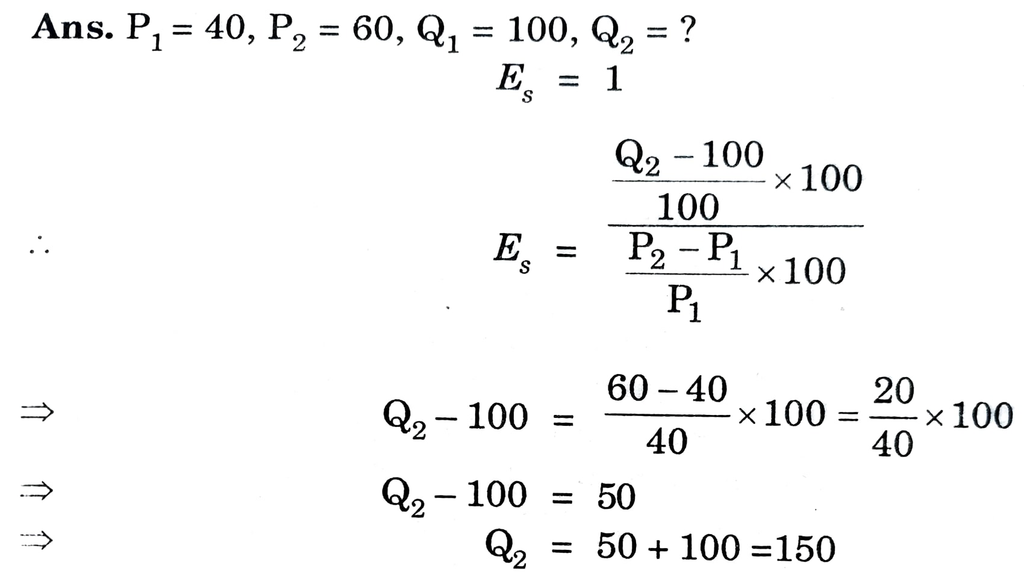
Q.4. A seller of commodity A supplies 200 units at a price of ₹ 2 per unit. At which price will he supply 300 units of it, if the price elasticity of supply is 0.5.


Q.5. What is price elasticity of supply of a straight line supply curve passing through the point of origin and making an angle of 70° to the x-axis.
Ans. Price elasticity of supply is one.
Q.6. What is price elasticity of supply if the straight line supply curve meets x-axis in its negative range.
Ans. Price elasticity of supply is greater than one.
INTEXT QUESTIONS 20.3
Q.1. What is the elasticity of supply of a commodity in the short period?
Ans. Supply is more price elastic the longer the time period that a firm is allowed to adjust its production levels. In some agricultural markets the momentary supply is fixed and is determined mainly by planting decisions made months before, and also climatic conditions, which affect the production yield. In contrast the supply of milk is price elastic because of a short time span from cows producing milk and product reaching the market place.
Q.2. What is the value of elasticity of supply in the long period.
Ans. Supply is more price elastic the longer the time period that a firm is allowed to adjust its production levels. In some agricultural markets the momentary supply is fixed and is determined mainly by planting decisions made months before, and also climatic conditions, which affect the production yield. In contrast the supply of milk is price elastic because of a short time span from cows producing milk and product reaching the market place.
Q.3. How does the cost of production of additional units of output influences the elasticity of supply of a commodity.
Ans. If there is plenty of spare capacity then, business can increase output without arise in costs an supply will be elastic in response to a change in demand. The supply of goods an services is most elastic during a recession, when there is plenty of spare labour and capital resources.
Q.4. How does nature of the commodity influence the elasticity of supply of a commodity?
Ans. Acts as a major determinant that influence the elasticity of supply. Goods, such as antiques and wines, cannot be reproduced in the same form; therefore the supply of such goods remains constant. Similarly in case of perishable goods such as vegetables, fruits and other eatables, the supply would be inelastic.
This is because the supply of perishable good cannot be increased or decreased easily. On the contrary in case of durable goods, such as furniture and electric appliances, the supply would be elastic as their supply can be increased or decreased quickly.
TERMINAL EXERCISE
Q.1. Define price elasticity of supply.
Ans. Price elasticity of supply measures the degree of responsiveness of quantity supplied of a commodity to change in its price. But the problem is that all the commodities do not respond in the same way to change in price. Some commodities are more responsive to change in price than others. For example, if the price of a commodity increases by 20 percent and it quantity supplied increase by 40 percent. In this case the supply of the commodity is very elastic because percentage in quantity supplied of the commodity is double the percentage change in its price.
Q.2. If two supply curves intersect each other at a point which of them is more elastic.
Ans. If two supply curves intersect each other, then the flatter supply curve will have more elasticity than the stuper supply curve. At the point of intersection of supply curves, flatter the curve, more elastic it is.
Q.3. What is meant by perfectly elastic supply?
Ans. When the quantity supplied of a commodity expands or contracts to any extent without any change or with an infinitely small change in its price, the supply of the commodity is called perfectly elastic. Its supply curve is a horizontal line parallel to x-axis. It can be shown with the help of the following supply schedule and supply curve.
Supply schedule of commodity B
| Price unit (₹) | Quantity supplied (units) |
| 10 | 100 |
| 10 | 200 |
| 10 | 300 |
| 10 | 400 |

The above supply schedule and supply curve show that at a price of 10 per unit the quantity supplied of the commodity may be 100, 200, 300 or 400 units. This type of supply is unrealistic because it is not possible in real life.
Q.4. What is the distinguish feature of unitary elastic supply?
Ans. An elasticity alternative in which changes in one variable (usually price) cause equal proportional changes in another variable (usually quantity). In other words, any change in price, whether big or small, triggers exactly the same percentage change in quantity. Quantity changes match price changes. This characterization of elasticity is most important for the price elasticity of demand and the price elasticity of supply! Unit elastic is one of five elasticity alternatives. The other four are perfectly elastic, perfectly inelastic, relatively elastic and relatively inelastic.
Unit elastic means that any change in price causes an equal proportion change in quantity. Quantity changes are matched by price changes. More specifically, the percentage change in quantity is equal to the percentage change in price. Unit elastic demand occurs when buyers can choose from among a modest number of substitutes in the consumption of a good. In an analogous way, unit elastic supply occurs when sellers can choose among a modest number of substitutes in the production.
Q.5. What is the value of elasticity of supply in the short period?
Ans. Perfectly inelastic supply means that quantity supplied is unaffected by any change in price. In other words, the quantity is essentially fixed. It does not matter how much price changes, quantity does not budget. Perfectly inelastic supply occurs when sellers have no choice in the production of a good.
Q.6. What is the value of elasticity of supply in the long period?
Ans. The longer the time period of analysis, the more responsive quantities are to price changes. Longer time periods allow sellers the time needed to find alternatives. For example, the supply of the Omni Motors Sports Corporation is not very elastic for a period of a few weeks or even months. Resources used in production cannot easily switch to other goods. However, given enough time, a year or more, resources can move between production, resulting in a more elastic supply.
Q.7. State any three factors determining price elasticity of supply.
Ans. The main factors that influence price elasticity of supply are:
1. Cost of Production: If production is subject to law of increasing costs, then supply of such goods will be inelastic. It is difficult to extend supply due to rise in price.
2. Time: Longer the time period, greater will be the elasticity of supply. On the other hand shorter the time period, small will be the elasticity of supply.
3. Availability of facilities for expanding output: Elasticity of supply also depends on the availability of facilities for expanding output. Farmers cannot raise their agricultural output with rise in the price of that output of facilities like seeds, fertilizers or irrigation facilities for expansion are not available. In such case price elasticity of supply will be less.
4. Risk taking: The elasticity of supply depends on the willingness of entrepreneurs to take risk. If entrepreneurs are willing to take risk, the supply will be more elastic. On the other hand, if the entrepreneurs hesitate to take risk, the supply will be inelastic.
5. Natural Constraints: The elasticity of supply is also influenced by the natural constraints in the production of a commodity. The nature places restrictions upon supply. If we wish to produce more teak wood, it will take years of plantation before it becomes usable.
Q.8. Explain the percentage method of determining elasticity of supply.
Ans. This is the most popular method of measurement of price elasticity of supply. With the help of this method we can calculate the accurate value of price elasticity of supply. This method measures the degree of responsiveness of quantity supplied of a commodity to change in its price. The price elasticity of supply is the ratio of percentage change in quantity supplied of a commodity to percentage change in its price. It can be calculated with the help of the following method:
Eₛ = Percentage change in quantity supplied/ Percentage change in price

where ∆Qₛ = Change in quantity supplied
ΔΡ = Change in price
P = Original price
Qₛ = Original quantity supplied
Percentage change in quantity supplied = ΔQₛ / Qₛ x 100
Percentage change in price = ΔP/P x 100
If we take original price as P₁ and changed price as P₂ this ∆P will be P₂ – P₁. In the same way if we take original quantity as Q₁ and changed quantity as Q₂ then ∆Q will be Q₂ – Q₁. The value of price elasticity of supply is always positive because there is a direct relationship between price and quantity supplied of commodity. Now we give some solved examples of price elasticity of supply with the help of which we can easily calculate price elasticity of supply of a commodity.
Q.9. State the geometric method of measuring elasticity of supply on a straight.
Ans. Geometric method of measuring price elasticity of supply: It is also called the point method. In this method, price elasticity of supply (Eₛ) is measured at a point of the supply curve. A supply curve can be linear (a straight line), or nonlinear (a hyperbola). In the figure S₁S is the supply curve. Now we want to find out Es at point P. Then the procedure is:

(a) Draw a perpendicular (a straight line from P parallel to Y-axis) intersecting X-axis at Q. This gives us output OQ, supplied at price P.
(b) Extend the supply curve leftwards intersecting X-axis at S₂Q. This gives us intercept S₂Q on X-axis.
(c) Divide the supply curve intercept S₂Q by supply of output OQ at point P. This gives Es at point P.
Eₛ at point P = Supply curve intercept on the x-axis / Supply at point P = S₂Q/OQ
Since S₂Q is greater than OQ, Eₛ is greater than one. The supply is elastic at point P. If the supply curve intercepts X-axis, Eₛ < 1 and if it intercepts the origin, Eₛ = 1.
Q.10. Explain the three factors that affect the elasticity of supply.
Ans. Various factors affecting the magnitude of price elasticity: Following factors affect the magnitude of price elasticity of supply:
1. Nature of the Commodity: Perishable commodities have inelastic supply, because their supply cannot be increased or decreased, even when price changes. Supply of durable goods is elastic, because their supply cannot be increased or decreased as a result of increase or decrease.
2. Technique of Production: If the technique of producing a commodity is quite complex and needs large stock of capital, then the supply of that commodity will be inelastic. On the other hand, goods involving simple technique of production will have elastic supply.
Increase in cost of production as compared to output: In cases where there is a significant increase in cost of production when output is increased, supply is inelastic. This is because suppliers will have to have to do a significant investment in order to increase the output. It will take time and some suppliers may be hesitant in doing so.
Improvement in Technology: In industries where there is a rapid improvement in technology, the PES of such goods will be more elastic as compared to industries where there is not much improvement in technology.
Stock of finished goods: In industries where there are high inventories/stocks of finished goods, the suppliers can easily supply more as the price rises. Thus, the PES for these goods will be elastic.
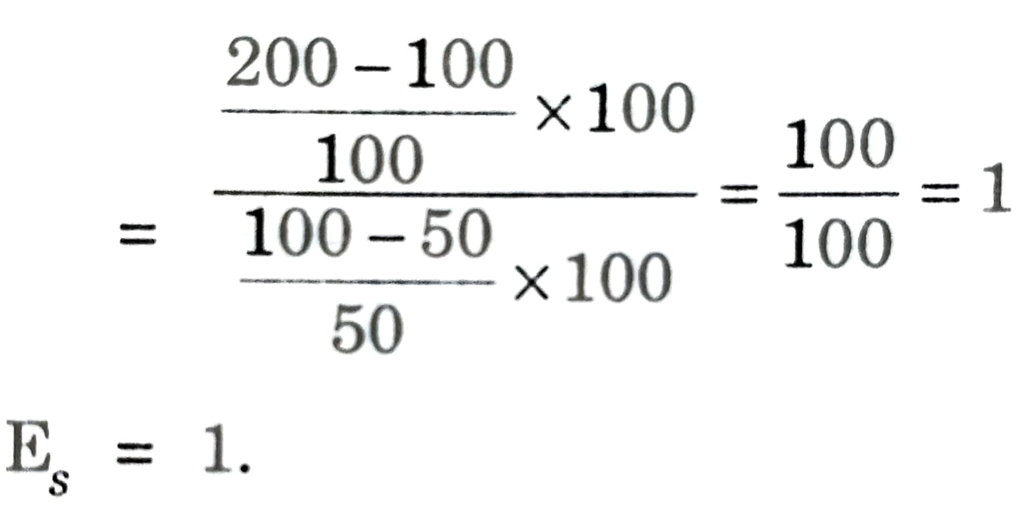
Q.11. At a price of ₹ 100 per unit, a seller sells 200 unit of the commodity and at a price of ₹ 50 per unit, he sells 100 units of the commodity. Calculate elasticity of supply.
Ans. Q₁ = 100, Q₂ = 200, P₁ = 50, P₂ = 100

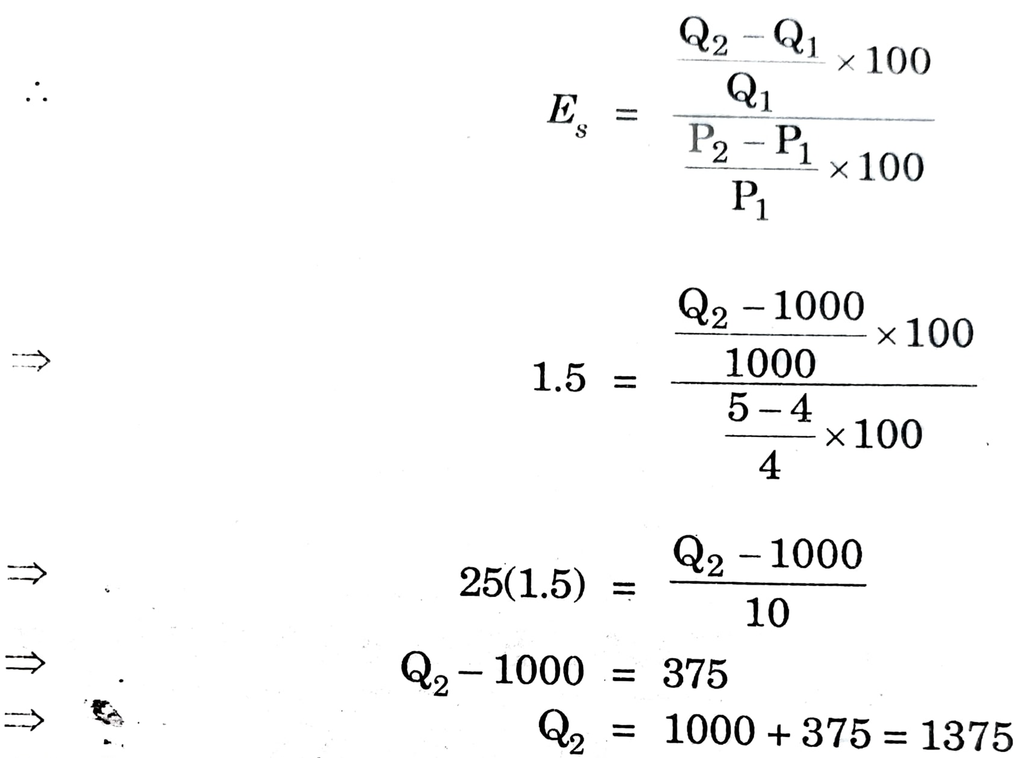
Q.12. Price elasticity of a supply of a commodity is 1.5. The seller sells 1000 unit of the commodity at a price of ₹ 4 per unit. How many unit of the commodity will be sold at a price of ₹ 5 per unit.
Ans. P₁ = 4, P₂ = 5, Q₁ = 1000, Q₂ = ?
Eₛ = 1.5
Q.13. At a price of ₹ 10 per unit, a firm earns total revenue as ₹ 5000. When the price rises ₹ 15, the firm earns ₹ 10000 as total revenue. Calculate its elasticity of supply and comment on it.
Ans. Q₁ = 5000, Q₂ = 10000, P₁ = 10, P₂ = 15
Eₛ = ?
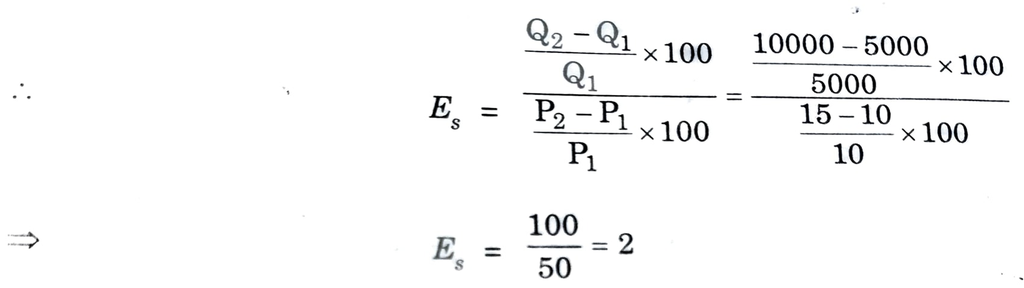
It is elastic or more than elastic.
Q.14. The price elasticity of supply of a commodity is 3. When its price falls from ₹ 10 to ₹ 8 its quantity suppled falls by 400 units. Calculate quantity supplied at reduced price.
Ans. Eₛ = 3, P₁ = 10, P₂ = 8, Q₂ = Q₁ – 400
Q₁ = 1

Quantity supplied at reduced price
= 666 – 400 = 2664 units.
Conclusion
We hope these NIOS Class 12 Economics Chapter 20 solutions have helped you understand the meaning and importance of price elasticity of supply. By studying the different degrees of elasticity, the percentage and geometric methods of measurement, and the factors that influence supply responsiveness, students can develop a clear understanding of how producers respond to price changes. The chapter’s numerical problems and supply curve explanations will also help improve your calculation and analytical skills. Practising all the textbook questions and answers will strengthen your understanding and support your examination preparation. These NIOS Class 12 Economics Chapter 20 solutions will help you revise the chapter and prepare confidently for your NIOS Class 12 Economics examination.