Welcome to the complete solutions of NIOS Class 12 Early Childhood and Education Chapter 17 – Qualities and Roles of an ECCE Teacher. This chapter explains the essential qualities, roles and responsibilities of teachers in Early Childhood Care and Education. It covers important aspects such as classroom management, curriculum planning, parent-teacher communication, inclusive education and creating an enriched learning environment for children. Here, you will find simple and easy-to-understand answers to all intext questions and terminal exercises to help you prepare for your examination. Explore NIOS Class 12 Early Childhood and Education Chapter 17 solutions for better understanding and effective revision.
NIOS Class 12 Early Childhood Care and Education Chapter – 17 Qualities and Roles of an ECCE Teacher
INTEXT QUESTIONS 17.1
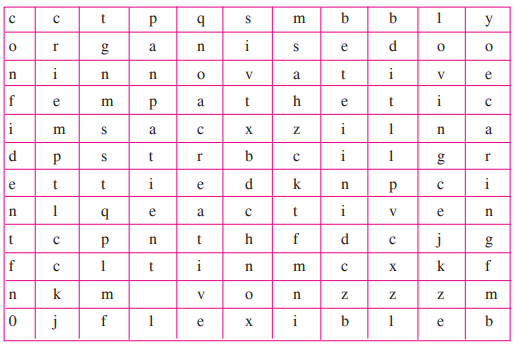
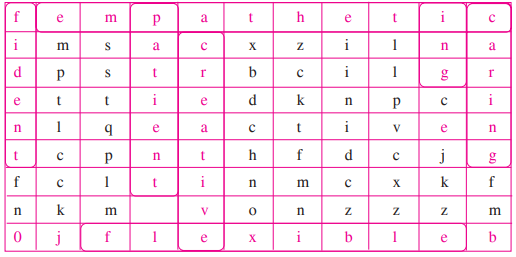
1. Identify the qualities of ECCE teachers in the given grid.
Ans:

2. Fill in the blanks.
1. Teachers have to manage a classroom full of children with diverse _____________ and _____________.
Ans: Needs, potential.
2. Teachers are required to keep themselves abreast of new _____________ and _____________ in the field of education.
Ans: Knowledge, developments.
3. Regular communication between parents and teachers help in understanding children’s _____________ and their _____________ stages.
Ans: Needs, developmental.
4. Teachers must be _____________. while planning and designing learning experiences for young children.
Ans: Flexible.
5. Children have different ways of expressing their _____________ and responding to situations.
Ans: Emotions.
6. An unconditional _____________ and care helps in developing a sense of _____________ between children and the teachers.
Ans: Love, trust.
INTEXT QUESTIONS 17.2
Fill in the blanks.
1. ECCE teachers should use ___________ low-cost and no-cost material.
Ans: Locally available.
2. Ample opportunities should be provided to children for their ___________ development.
Ans: Holistic.
3. Teachers may creatively ___________ and ___________ material in an innovative manner.
Ans: Use, recycle.
4. ___________ and ___________ planning is essential and helps in attaining the desired outcomes.
Ans: Thoughtful, systematic.
5. Teachers should actively contribute in designing the ___________.
Ans: Curriculum.
6. Children with disabilities must be provided the required support in their ___________ and ___________.
Ans: Development, learning.
| Terminal Exercises |
1. Briefly explain the roles and responsibilities of ECCE teachers.
Ans: (i) Scheduling and organising parent-teacher meetings.
(ii) Organising special talks/interaction for children on topics significant and related to their day-to-day life, conducting orientation programmes and workshops for parents and community members.
(iii) Ensuring that every child in the classroom feels respected, accepted and welcomed; address the existing diversity in the classroom. Children with disabilities must be provided the required support in their development and learning.
(iv) Organising age-appropriate, developmentally appropriate, engaging and interesting learning experiences. All children should be provided with ample opportunities to play, observe, manipulate, interact, explore and experiment.
(vi) Using a variety of teaching learning material to make learning interesting and meaningful. Create the learning material using locally available low-cost and no-cost materials, creatively use and recycle material in an innovative manner using teaching learning material in multiple ways.
(vii) Organise and manage classrooms: Allocate the space for different activities, select age-appropriate equipment and learning materials and organise classroom space.
(viii) Design and successfully implement ECCE Curriculum.
(ix) Provide an emotionally safe and positive environment full of praise, encouragement and support for children to feel comfortable and happy.
(x) Planning a number of activities including curriculum, time table, age-appropriate indoor and outdoor learning activities, assessment procedures, parent teachers meeting, workshops etc.
(xi) Conduct regular assessment.
2. Discuss the qualities of ECCE teachers.
Ans: (i) Loving and caring.
(ii) Creative and innovative.
(iii) Patient and persistent.
(iv) An active and empathetic listener.
(v) Energetic, enthusiastic and motivated.
(vi) Cheerful and committed.
(vii) Flexible and adjusting.
(viii) Organised.
(ix) Self-confidence and high self-esteem.
(x) An effective communicator.
(xi) Effective in building rapport with parents and community.
(xii) Research skills and lifelong learner.
3. How can ECCE teachers create an enriched learning environment for children?
Ans: ECCE teachers should use and create the learning material using locally available low-cost and no-cost materials, creatively use and recycle material in an innovative manner using teaching learning material in multiple ways.
They should organise age-and developmentally appropriate, engaging and interesting learning experiences. All children should be provided with ample opportunities to play, observe, manipulate, interact, explore and experiment.
Teachers have the responsibility to ensure that every child in the classroom feels respected, accepted and welcomed. To address the existing diversity in the classroom, teachers are required to organise the learning process in such a manner that all children get an opportunity to participate and express themselves. Children with disabilities must be provided the required support in their development and learning.
Conclusion
We hope these solutions of NIOS Class 12 Early Childhood and Education Chapter 17 have helped you understand the qualities and roles of an ECCE teacher. A good teacher plays an important role in children’s overall development by creating a safe, supportive, inclusive and engaging learning environment. From classroom management and curriculum planning to parent communication and regular assessment, every responsibility contributes to effective early childhood education. Practising these answers will help you revise the chapter and prepare effectively for your examination. Revise NIOS Class 12 Early Childhood and Education Chapter 17 regularly for better exam preparation.