NIOS Class 10 Social Science Chapter 26 Environmental Degradation and Disaster Management explains the importance of the environment, the causes of environmental degradation and ways to protect natural resources. This chapter covers biotic and abiotic components, natural and human-made environments, pollution, biodiversity loss and the effects of human activities on the environment. Students will also learn about natural and man-made disasters, disaster management strategies and measures to minimize their harmful effects. NIOS Class 10 Social Science Chapter 26 includes important textbook questions and answers to help students understand these topics and prepare effectively for examinations.
NIOS Class 10 Social Science Chapter – 26 Environmental Degradation and Disaster Management
TEXT BOOK QUESTIONS WITH THEIR ANSWERS
INTEXT QUESTIONS 26.1
Q. 1. Put the following into biotic and abiotic groups:
Plants, Water, Soil, Animals, Fire, Microbes, Topography, Bacteria.
Ans:
| Biotic | Abiotic |
| Plants | Water |
| Animals | Soil |
| Microbes | Fire |
| Bacteria | Topography |
Q. 2. Fill in the blanks with appropriate words:
(a) Environment can be classified into ________ and ________.
Ans: Natural, human made.
(b) The classification of environment can also be made on the basis of its ________.
Ans: Creation or evolution.
(c) Road, buildings and school are parts of ________ environment.
Ans: Human made.
(d) Environment is dynamic because ________.
Ans: It changes were period of time and space.
Q. 3. Activity – Make a list of things around you and classify them into two categories. In the first category mention those things that are essential for your living and in the second category put those things that you can live without.
Ans: Self attempted.
INTEXT QUESTIONS 26.2
Q. 1. Fill in the blanks with appropriate words:
(a) When habitats are destroyed _________ is lost.
Ans: Biodiversity.
(b) Modern gadgets release _________ and causes _________.
Ans: Harmful gasses, global warming.
(c) Extensive use of fertilizers and pesticides have been a major source of _________ and _________.
Ans: Contamination of water bodies, land degradation.
(d) One of the biggest causes of environ- mental degradation is generation of _________.
Ans: Solid waste.
Q. 2. What is a disaster? Give one example.
Ans: A disaster is a tragedy that affects society and the environment in a negative way. It is seen as the consequences of in- appropriately managed risk.
Example: (i) Landslides are examples of natural disasters.
(ii) Bhopal Gas Tragedy is an example of man-made disaster.
Q. 3. Activity: Garbage survey
For waste management, it is necessary that we collect the wastes for disposing them off in three ways and take the needed steps, i.e., recycle or reuse or reduce them. In this context you have to observe what type of waste is disposed of in your house/area/colony? Carry out a weekly survey in your house/area/locality in the following format and write which of the wastes can be recycled, reused or reduced:

Write in the above table the names of garbage generated in your house on each day of the week. After one week, see which type of garbage is generated the most. Try to reuse or reduce as explained in the lesson above. Do the same exercise for another week and compare the results of two weeks. You may find that the garbage under ‘Reduce’ has decreased substantially.
Ans: Students will carry out the survey themselves and complete the given table.
Q. 4. List the activities by which we degrade the environment.
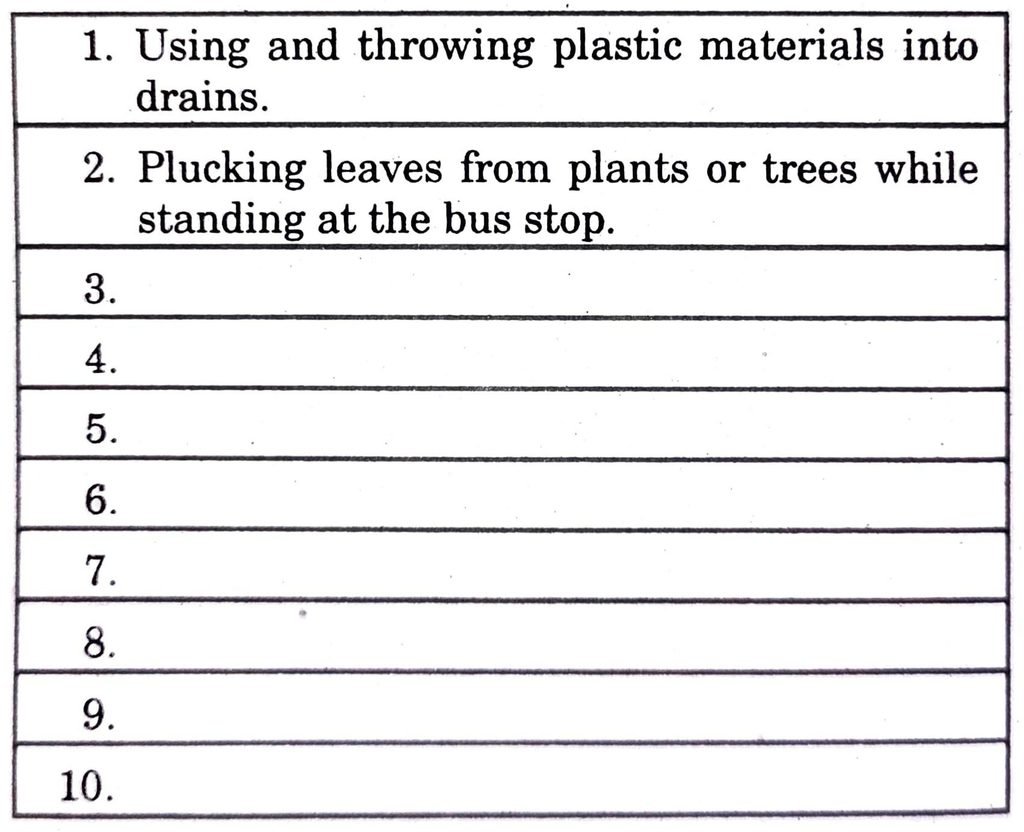
Ans: Students will do this activity themselves.
TERMINAL EXERCISES
Q. 1. What is meant by environment? Explain it with the help of an example.
Ans: Anything that surrounds us is known as our environment. See the given figure. A couple is walking, and playing with their two children in surrounding environment i.e. in a park with a lot of trees, flowers, grass and butterflies.

Q. 2. Classify the environment on the basis of evolution. Explain them from the examples of your surroundings.
Ans: The environment can be classified as a natural and human made environment on the basis of its evolution or creation.
A natural environment includes all our natural surroundings or non-living and living things which are naturally available on the surface of the earth. Human made environment consists of all the buildings, but by humans in our surrounding.
Q. 3. ‘The environment is dynamic in nature and keeps on changing.’ Substantiate this statement with examples.
Ans: The environment is dynamic in nature and keeps on changing. Both of its elements biotic and abiotic are also dynamic in nature. These are different from place to place and one place to another. If you observe the evolution of an environment at a place over the period of five to ten years or so, you will find a lot of changes in it. These changes occur naturally as well as human beings interference in her surroundings. Thus, the environment is dynamic in nature, but keeps on changing as the time passes.
Q. 4. Discuss in brief the importance of the environment.
Ans: Importance of Environment:
(i) It is our basic support system.
(ii) It is key to our welfare and survival.
(iii) It affects and influences the growth, development and survival of the organisms.
(iv) We depend on the environment for our food, shelter, water, soil, energy etc.
(v) It maintains ecological balance.
(vi) It maintains atmospheric composition.
Q. 5. Define environmental degradation. Explain the factors causing environmental degradation.
Ans: Environmental degradation is a process by which our environment is progressively contaminated, over exploited and destroyed. So we can say environment degradation is the deterioration of the environment through depletion of natural resources.
Causes:
(i) Social Factors: Social factors which are responsible for environment degradation are
(a) Population growth.
(b) Poverty.
(c) Urbanization. and
(d) Changing lifestyle.
(ii) Economic Factors: Economic factors which are responsible for environ- mental degradation are:
(a) Agricultural Development.
(b) Industrialisation.
(c) Economic Development.
Q. 6. Suggest any three ways to save our environment.
Ans: Three ways to save our environment are:
(i) Always use and promote eco-friendly and biodegradable products.
(ii) Segregate home garbage to facilitate the recycling process.
(iii) Demand eco-friendly refrigerators and air conditioning which do not use CFCs.
Q. 7. List at least ten activities by which human beings have been degrading the environment.
Ans: Self attempt.
Q. 8. Classify the disaster on the basis of their origin.
Ans: On the basis of their origin disaster can be classified as:
(i) Natural Disaster.
(ii) Man-made Disaster.
Q. 9. What is meant by Disaster Management? How can we minimize the adverse effects of disasters?
Ans: Disaster Management is an effort made to minimize the adverse effects of natural and man-made disasters by adopting suitable strategies.
These suitable strategies involved to minimize disaster impact are:
(i) Mitigation.
(ii) Preparedness.
(iii) Response.
(iv) Recovery.
Conclusion
Protecting the environment is essential for maintaining ecological balance and ensuring the survival and well-being of living organisms. Reducing waste, recycling materials, using eco-friendly products and limiting harmful human activities can help prevent environmental degradation. Effective disaster management, including mitigation, preparedness, response and recovery, is equally important for reducing the impact of natural and man-made disasters. NIOS Class 10 Social Science Chapter 26 helps students understand environmental challenges and the importance of disaster management. By revising NIOS Class 10 Social Science Chapter 26, students can strengthen their knowledge and prepare confidently for examinations.