NIOS Class 10 English Chapter 20 – New Good Things From Rubbish is an informative lesson that explains the importance of recycling, reusing and reducing waste to protect our environment. The chapter discusses how paper, plastic, metal and glass can be reused or recycled instead of being thrown away or burnt. It also highlights the importance of saving natural resources, reducing pollution and adopting eco-friendly habits. In this NIOS Class 10 English Chapter 20, students learn about recycling processes, environmental conservation, conjunctions, vocabulary, informal letter writing and important questions and answers for examination preparation.
NIOS Class 10 English Chapter – 20 New Good Things From Rubbish
BOOK – II
LET US UNDERSTAND THE TEXT
20.2.1 PART – 1
Recycling rubbish ……………….. even some plastics.
Reusing rubbish is one of the important ways of reducing pollution. Rubbish which is not reused is disposed of by burning. This leads to pollution. The cutting down of thousands of trees for the purpose of printing newspapers leads to a waste of the earth’s resources. Instead, if we reuse the most commonly used paper, metal, glass and plastic objects, it will help us save natural resources and our environment.
INTEXT QUESTIONS 20.1
I. State which of the following statements are false and why:
(a) Recycling is the need of the hour.
Ans. Recycling is the need of the hour – True.
(b) We should burn our rubbish.
Ans. We should burn our rubbish- false. Burning will create pollution
(c) Recycling means reusing waste material.
Ans. Recycling means reusing waste material – true.
(d) Thousands of trees are felled to print the Sunday edition of the New York Times.
Ans. Thousands of trees are felled to print the Sunday edition of the New York Times – True.
II. How is the reusing of waste beneficial? Explain.
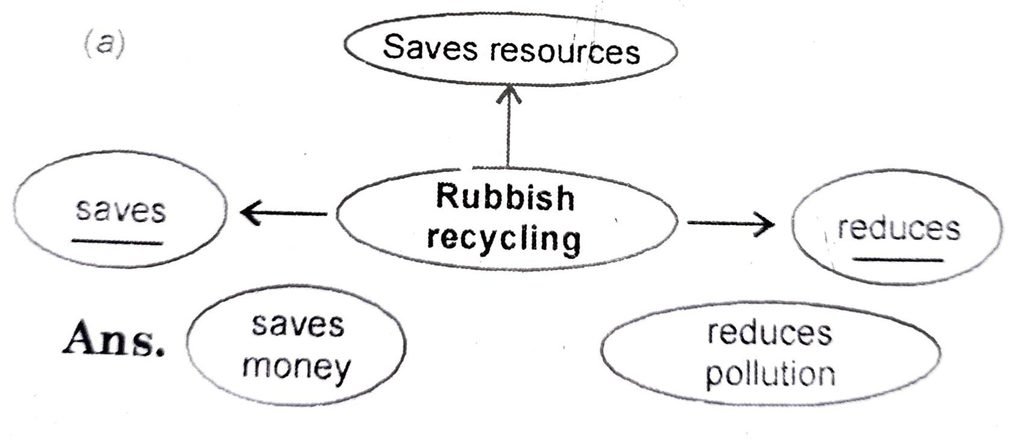
Ans. By resuing waste we save money and lessen pollution.
III. Summarise the passage by completing the following web:

10.2.2 PART – 2
Plastic is one ……………. since the early 1980’s.
It is not easy to recycle plastic. It is also not possible to make good quality plastic products out of recycled plastic. But it does not mean that plastic is a complete waste after it has been used once. Some of the plastic we use can be reused for filling cushions or recycled for making fences. Metal products can be reused in many ways. Metal recycling not only saves natural resources, but also a lot of electricity and energy.
IN TEXT QUESTIONS 20.2
I. State which of the following statements are false and why.
(a) It is simple to recycle plastic.
Ans. It is simple to recycle plastic – false. It is difficult because it comes in many varieties.
(b) We should avoid recycling aluminium.
Ans. We should avoid recycling aluminium – False.
When we recycle aluminium we extract it from Bauxtic which consumes a huge amount of electricity.
(c) A new shining car has components of old cars.
Ans. A new shining car has components of old card – True.
(d) It is always beneficial to recycle valuable metals.
Ans. It is always beneficial to recycling valuable mentals – True.
II. How is metal recycling different from plastic recycling?
Ans. Metal recycling is cheaper to do and most beneficial. All of the metal is used up.
Plastic recycling is difficult and lot of waste is thrown away.
III. In the first line of the last para, the word more is used twice.
Make a sentence using more in a similar
way.
E.g. the more respect you give the more
you get.
Ans. The more you work the more you earn.
IV. Circle the objects which can be recycled from the given graphics:
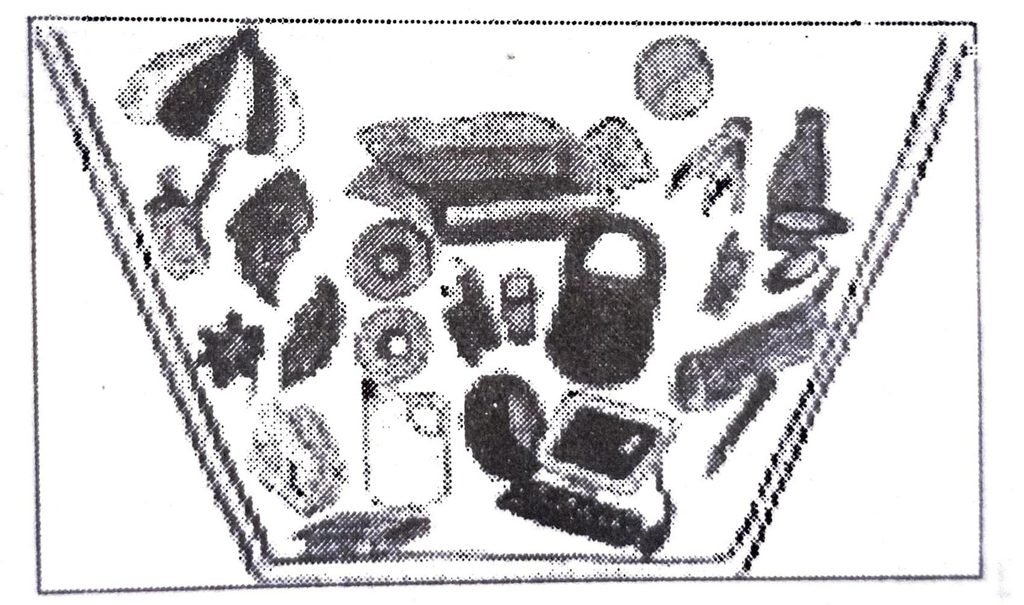
Ans. Self Activity.
V. Summarise the paragraph in Part 2 by completing the following web:

Ans. Many varieties.
(b) No simple way to convert old plastic bottle into new one.
(c) recycled products are of lower quality.
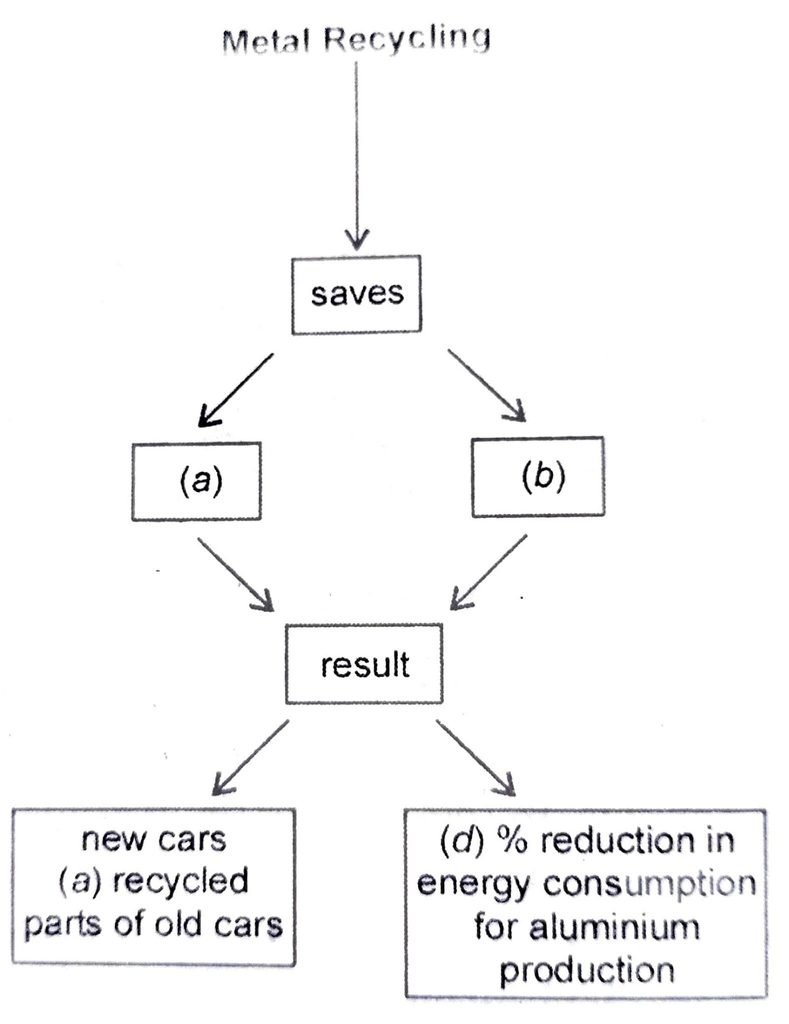
(a) metal
(b) bauxite
(c) will consist of
(d) 25% reduction of energy consump- tion for aluminium production
LET US DO 20.3
After reading the lesson so far, you feel deeply about the important issue of preserving nature and its resources. You want to raise awareness and concern for it.
Write a letter to your cousin suggesting various ways that may help him/her to become eco-friendly in day to day life.
A few ways are-suggested below:
reuse plastic/glass bottles, use handkerchiefs instead of paper tissues, reuse gift papers, and so on. Suggest 4-5 more ways in your letter to your cousin.
Given below is a format for an informal letter Sender’s Address
Date
Dear__________
Body of the letter
______________________________
______________________________
Your loving friend,
______________
Ans. Room No, 103,
Shivalik Hostel
16 December, 20XX
Dear Rekha
I hope everything is fine at your end. I, too, am feeling fine in the Hostel. In this letter I am writing you about the eco-friendly environment and ways to preserve.
I am giving you a few suggestions about recycling. You know to save the environment we must reduce reuse, recycle metal and plastic. We can reuse glass bottle we should avoid using paper tissues but used handkerchiefs which can be rewashsed. A lot of paper is wasted by throwing away gift paper. If gift papers are kept folded, they can be reused. Every bit of scrap or metal should be used. We should also avoid using paper plates which can save felling down of trees. I hope you also be inspired and take steps to save the environment yours loving friend. Sukanya
20.2.3 PART – 3
Glass is best…………… all of us need to think about.
The best way to save glass is to reuse glass bottles and other glass objects to the maximum. Glass can also be recycled to form new glass objects. Recycling broken glass of mixed colours only produces green coloured glass. Therefore, the best way to recycle glass is to separate broken glass by colour, and then remelt it to produce new glass objects. Another important material that should be recycled is paper, as half of the world’s waste is paper. In general in India we reuse a lot of things and avoid waste. But in the twenty first century we Indians copy some of the wasteful habits of people in western countries (such as using more and more disposable paper items for the sake of convenience). We should be aware of these changes in our habits and try to control them. All of us should try to check waste in any form.
INTEXT QUESTIONS 20.3
I. State which of the following statements are false and why?
(a) Glass bottles can be used over and over again.
Ans. Glass bottles can be used over and over again – (True).
(b) Copying western habits may lead Indians towards wasting resources.
Ans. Copying Western habits may lead Indians towards wasting resources – (True).
(c) The British are more successful in recovering glass than the Dutch.
Ans. The British are more successful in recovering glass than the Dutch – (False).
(d) Glass once broken in a waste material.
Ans. Dutch are 50% successful while British are 12% successful Glass once broken is a waste natural – (False).
Broken glass can be recycled.
II. Suggest two ways in which a student can avoid wastage of paper.
Ans. A student should leave very small margin on the sheet of paper. They should write in both sides of the paper. They should never throw any gift paper or packing paper.
III. In the sentence ‘Half the world’s waste consists of paper’, waste is used as a noun.
Make a sentence using waste as a verb. e.g. If we waste we can not get it back.
Ans. Wasting is a bad habit.
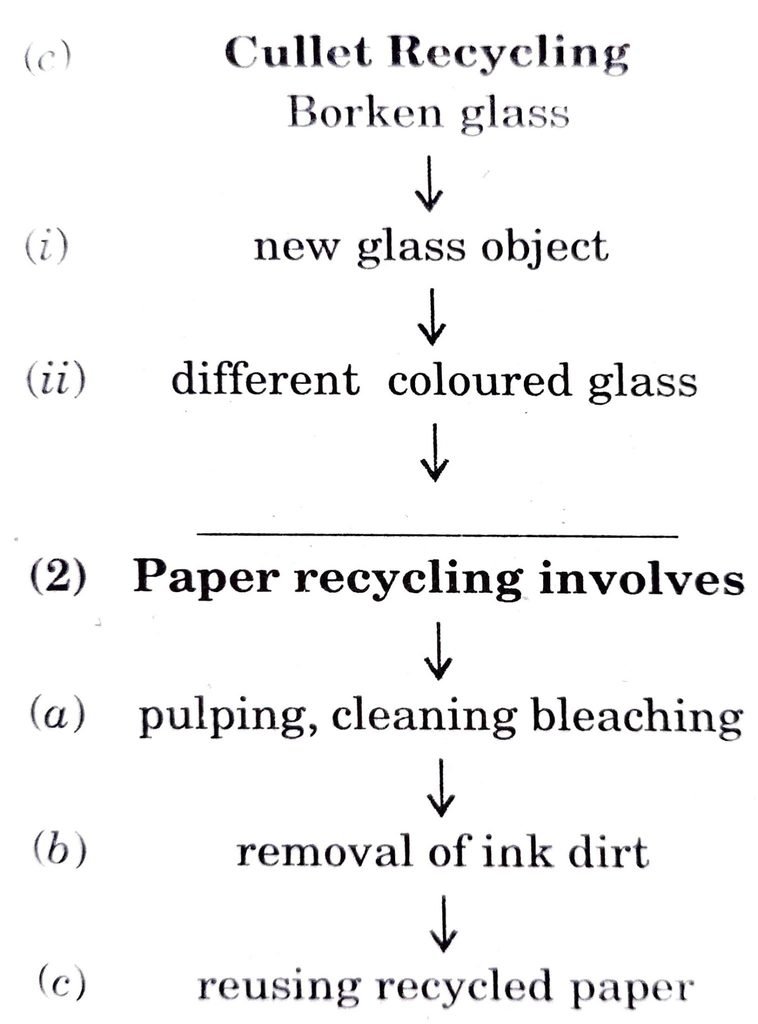
IV. Complete the following webs showing the processes of recycling various materials:
1. Glass Recycling.
(a) The most sensible way – Reuse.
(i) Glass bottle used 30 times.

LET US LEARN NEW WORDS 20.1
Q. 1. Underline the words which do not constitute our natural resources.
| air, water, earth, plastic, trees, paper, gold, glass. |
Ans. plastic, gold, glass.
Q.2. Match the describing words with the nouns they describe:
| Describing word | Noun |
| valuable | bottles |
| coloured | metals |
| western | glass |
| plastic | countries |
| precious | resources |
| E.g: plastic bottles |
Ans.
| Describing word | Noun |
| valuable | resources |
| coloured | glass |
| western | countries |
| plastic | bottles |
| precious | metals |
| E.g: plastic bottles |
1. Fill in the blanks with appropriate conjunctions from the brackets.
(a) Make hay_______ the sunshines, (when, while)
Ans. Make hay while the sunshines.
(b) She must sleep_______she will fall sick, (or, and)
Ans. She must sleep or she will fall sick.
(c) You reap_______ you sow, (as, so)
Ans. You reap as you sow.
(d) The sky is neither cloudy_______ bright, (or, not)
Ans. The sky is neither cloudy nor bright.
(e) She is poor_______happy (but, though)
Ans. She is poor but happy.
2. Find out one example each of coordinating and subordinating conjunctions in UNIT III of the lesson.
3. The following passage has not been edited. The conjunction in each line is incorrect. Underline the error and write the correct conjunction in the blank space alongside.
Turmeric has sacred so well as medicinal value.
(a) ________________.
Ans. so – as.
It is native to India yet it is now grown.
(b) _________________.
Ans. yes – still.
in many countries in Asia or Africa.
(c) _________________.
Ans. or – and.
Researches establish while it can be used.
(d) _________________.
Ans. while – that.
for colouring paints but varnishes.
(e) __________________.
Ans. but – and.
It is used that as a medicine
(f) ___________________.
Ans. that – also.
Yet also as an inexpensive beauty aid.
(g) __________________.
Ans. yet – but.
TERMINAL QUESTIONS
I. Complete the following using the correct alternatives:
Q.1. Recycling refers to
(a) the conversion of waste materials into new and useful things.
(b) the conversion of new and useful things into some other form.
(c) the conversion of old useful things into a different form.
Ans. (a) the conversion of waste materials into new and useful things.
Q.2. Rubbish burning should be avoided to:
(a) create pollution.
(b) increase pollution.
(c) reduce pollution.
Ans. (c) reduce pollution.
Q.3. Plastic recycling is the most difficult because of:
(a) its various colours.
(b) its various varieties.
(c) its various sizes.
Ans. (b) its various varieties.
II. Answer the following in not more than 50 words:
Q.1. Why is it important to recycle waste?
Ans. It is important to recycle waster. So that we can save environment. If we burn rubbish we save resources.
Q.2. How can recycling help in checking global warming?
Ans. If we recycle the rubbish, we shall not burn the rubbish. This should not give out smoke and save us from global warming.
Q.3. Reduce, Reuse, Recycle shall be our motto.
(a) Explain why this should be our motto.
Ans. Reduce: Reuse and Recycle should be our motto so that we can save important resources and protect environment.
(b) Give more example of each action in daily life.
Ans. Reduce: It means that if we lessen pollution we save valuable resources.
Reuse: We can use glass bottles again and again.
Recycle: We can recycle gold to make new ornaments.
Q.4. Think of an alternative title for the passage and justify it?
Ans. Another title can be “Process to beautify earth.”
By this process, we can save earth from being polluted and reuse the things.
Q.5. Imagine that no waste material is recycled. What would be the outcome? Write any three outcomes.
Ans. If no waste material is recycled we would face:
(a) These problem earth would become heap of rubbish.
(b) We would burn rubbish and make the atmosphere toxic.
(c) The earth would become dumping ground.
Q.6. Complete the following slogans:
Recycle paper Save ___________.
Ans. Recycle paper Save Trees.
Recycle metals Save ____________.
Ans. Recycle metals Save energy.
Recycle today Save ____________.
Ans. Recycle today Save tomorrow.
Conclusion
NIOS Class 10 English Chapter 20 – New Good Things From Rubbish gives an important message that waste materials can be turned into useful things through proper recycling and reuse. The lesson encourages students to follow the principle of Reduce, Reuse and Recycle to conserve natural resources, control pollution and protect the environment. It also develops awareness about responsible consumption and eco-friendly habits. Through this NIOS Class 10 English Chapter 20, students strengthen their understanding of recycling while improving vocabulary, grammar, letter writing and comprehension skills for examinations.