NIOS Class 10 English Chapter 3 – Kondiba – A Hero is an inspiring lesson about courage, determination, empathy and the ability to remain calm during a difficult situation. The story presents Kondiba, a visually challenged man who bravely risks his own life to rescue a young boy named Arvind from a deep well. Despite his blindness and physical weakness, Kondiba does not give up and finally succeeds in saving the boy. In this NIOS Class 10 English Chapter 3, students will find important questions and answers, vocabulary, grammar exercises, writing activities, listening and speaking activities, and terminal questions based on the lesson. The chapter also gives an important message about respecting and valuing the abilities of differently-abled people.
NIOS Class 10 English Chapter – 3 Kondiba – A Hero
BOOK – I
LET US DO 3.1
(A) Newspaper and magazines publish the stories of people who become heroes because of their bravery, compassion, empathy or ability of decision-making in difficult or critical circumstances. Cut out the stories of such people and paste them in a scrap file. Collect at least five such stories.
(B) Write in 3–4 sentences how the actions of the people in the stories influenced you.
Ans. (A) class Activity.
INTEXT QUESTIONS 3.1
Q.1. When and how did Kondiba become blind?
Ans. Kondiba became blind at the age of six because of smallpox.
Q.2. Kondiba hated begging, but he had to beg. Why did he start begging? Give two reasons to complete the following statement:
(a) He could not ____________.
Ans. He could not earn much by selling brooms.
(b) He come to know that the beggars _________.
Ans. He come to know that beggars could earn well in Mumbai.
Q.3. If you were in Kondiba’s place and would lose your eyesight what would you do?
Ans. If I had been in Kondiba’s place and had lost my eyesight then I might not have and so bravely I would have worked for my well being.
Q.4. Who had dug the well? Where was it dug?
Ans. The well had been dug by residents of Golibar slum. It was dug in the centre of the colony
Q.5. Why was the well dug?
Ans. The well was dug because the tap water was not enough for all the people living in the colony.
Q.6. What had happened to the water in the well within two years?
Ans. In two years water in the well had turned blackish green.
Q.7. What happened one day when Kondiba was having food?
Ans. One day when Kondiba was having food he heard a women crying out. He heard that she had fallen into the well.
3.2.2. PART – 2
Kondiba….disappointment.
In the previous section, we read that one day when Kondiba was having his meal, he heard a woman cry out that someone had fallen into the well.
Kondiba asks a woman to take him to the well. He knows how to swim. He was good swimmer as a young boy, but poverty has made him weak. Without considering this Kondiba jumps into the well to save a young boy named Arvind. Don’t you think he is very brave to do so?
He dives down again and again to search for the boy but cannot find him. And each time he Comes up he feels more and more tired. The people standing near the well feel disappointed each time Kondiba comes up without Arvind. Do you think Kondiba continues to search for Arvind? Think.
INTEXT QUESTIONS 3.2
Q.1. What did Kondiba do as soon as he heard that someone had fallen into the well?
Ans. He left his food and asked Yelanbai to take him to the well.
Q.2. Tick the correct sentence:
When Kondiba reached the well,
(a) he found that Arvind had fallen into the well.
(b) he felt helpless as he had no sight.
(c) he dived into the well to save Arvind.
Ans. (c) He dived into the well to save Arvind.
Q.3. How many times did Kondiba go into the well? Was his experience the same or different every time?
Ans. Kondiba went into the well twice. His experience was different every time. First time, he reached the bottom by feeling along the rocks on the side of the well. Next time he felt shape of the well. Then he went straight into the bottom.
Q.4. Why was the crowd disappointed?
Ans. The crowd was disappointed because Kondiba could not find Arvind.
Q.5. If you were Kondiba, what would you do in such a situation?
Ans. If I was Kondiba. I would have also acted bravely. I know life of a person is precious.
DO YOU KNOW
How to help oneself and others in emergencies / disastrous situations
In life, we come across accidents like fires, plane crashes, road accidents, and cases of drowning as well as calamities such as floods, earthquakes, cyclones or terror attacks. In all these emergencies, we can improve the survival rates with our preparedness and empathy towards others.
We only need to remember the following rules:
- Be brave and stay calm. Certain coping devices like controlled, rhythmic breathing can keep anxiety under control.
- Make a thorough assessment of the situation.
- Think of possibilities.
- Be sure you have enough information required to help yourself or rescue a person or persons.
- Even though you need to take quick action, take a moment to think clearly as to what you should do. Do not do anything that will endanger you or others. Do not hesitate to ask others to assist you or to raise the alert.
LET US DO 3.2
Q. 1. You are at the railway platform waiting to board a train. You hear a loud explosion and see injured people lying around. Discuss the situation with a friend. In 3-5 sentences explain the three most important things that you would do in this situation.
Ans. In such a situation people panic. The first thing is to call the police and try to talk to injured people. Take injured to some calm place. Try to contact their reaches if possible. Give them water and keep them attended.
Q.2. Think of the kind of accidents that could occur in your home or neighbourhood. What items will you need to provide first aid? With help from a doctor in your locality prepare a first aid kit which will be useful in handling these common accidents that happen in the home or in the neighbourhood.
Ans. Many accidents take place in our home or neighbourhood. In our home we can get electric shock, a fall in slippery floor. There can also be explosion due to gas cylinder. Fire can also take place due to short circuit.
A few things which must always be present at home are:
(a) Bandage.
(b) Cotton.
(c ) Dettol.
(d) Burnol.
(e) Antiseptic Cream.
(f) Pain Killers.
(g) A pair of scissors.
3.2.3. PART – 3
Never in …………..beg again?
Kondiba tries again and again to find Arvind in the deep well. He wishes he was not blind, because if he could see he would be able to see Arvind and save him. Do you think Kondiba gives up? Though he feels very tired and feels that his body will not be able to do any more, he does not stop searching. He dives down once more. This time he feels Arivind’s clothes against his hand. He quickly holds on to Arvind’s belt and brings him out. Arvind is taken to the hospital. Kondiba thinks that he has to carry on with his life as a beggar but his life changes. People hear of his bravery and reward him and Kondiba is now able to give up begging, which he had hated to do.
INTEXT QUESTIONS 3.2
Answer the following briefly:
Q.1. What did Kondiba miss most now? Why?
Ans. He missed his vision. He had to try very hard to find Arvind.
Q.2. Underline all the expression/ sentences that describe that Kondiba was very tired?
Ans. Some of the expressions are as follows: Panting heavily, tired, Kondiba’s heart was beating painfully-painfully His spine and muscles ached.
Q.3. Kondiba was tired but he did not give up hope. Why? Give two reasons.
Ans. He was sure that Arvind must be in the well. He knew that Arvind could not Vanish. He could not give up trying.
Q.4. What does ‘The net’ refer to?
Ans. Net refers to the weeds which were around Arvind.
Q. 5. How did Kondiba free the boy from the weeds?
Ans. Kondiba put in great efforts. He caught hold of his belt and pulled him out of the weeds.
Q.6. ‘It seemed a long time’. For whom did it seem too long? Why?
Ans. For Kondiba it was a long time. In fact after many years he had got into water It was difficult for him to hold his breathe.
Q.7. When Kondiba came up to the surface, what three things did the crowd do?
Ans. The crowd lifted Arvind out of the well. Secondly they gave artificial respiration to Arvind. Thirdly he was rushed to the hospital.
Q.8. (a) How did Kondiba feel when he brought Arvind out of the well?
Ans. Kondiba was so tired that he did not show any reaction.
(b) If you were in Kondiba’s place, how would you have felt ?
Ans. If I had been in Kondiba’s place I would have felt very happy and overjoyed.
Q.9, What did the policeman tell Kondiba? What would have happened to Arvind, if he had not saved him just in time?
Ans. The policeman told Kondiba that Arvind would be alright. If Arvind had not been saved vin time, he might have died.
Q.10. What publicity did Kondiba get?
Ans. Kondiba’s picture and his tale of bravery was published in newspaper. He was praised by the Governor and C.M of Maharashtra.
Q. 11. How was Kondiba rewarded?
Ans. Kondiba was given a reward of Rs. 12,970/ He was taught skills of bottling and weaving chairs.
Q.12. How did Kondiba utilize his prize money and skills?
Ans. With the help of prize money Kondiba was able to open up a small business.
Q.13. What does his example prove?
Ans. The example proves that if we have courage and care for others, nothing can stop us from getting success.
LET US LEARN NEW WORDS 3.1
Exercise
Q.1. Given below are two lists-one of describing words (adjectives) and the other of naming words (nouns).
Scan through (quickly glance through) the text and match the words in the two lists. Try to do it within five minutes. One has been done for you.
| Describing words | Naming words |
| Gunny | day |
| daring | huts |
| starved | depths |
| muddy | bag |
| cloudy | water |
| growing | weed |
| broken | body |
| slippery | pottery |
| half-eaten | rescue |
| blackish-green | population |
| surrounding | meal |
Remember, some of the describing words given above may be used as verbs also. For example, I have broken my leg. Here ‘broken’ is the third form of the verb ‘break’.
Ans.
| Describing words | Naming words |
| Gunny | bag |
| daring | rescue |
| starved | body |
| muddy | depths |
| cloudy | day |
| growing | population |
| broken | pottery |
| slippery | weeds |
| half-eaten | meal |
| blackish-green | water |
| surrounding | huts |
Q. 2. Give at least one more describing word for each noun given in Exercise 1, for example, sunny day.
Phrasal Verbs
A phrasal verb is a simple verb combined with an adverb or a preposition or sometimes both to make a new verb with a meaning that is different from that of the simple verb. For example, read the sentence ‘Kondiba’s life had to go on. In this sentence ‘go on’ means ‘continue’
Ans. daring – Act
starved – boy
muddy – roads
cloudy – season
growing – houses
broken – glass
slippery – beach
half-eaten – animal
brackish green – sea
surroundings – forest
Q.3. In this lesson, you came across a number of phrasal verbs. Complete the following summary of sections II and III using appropriate phrasal verbs. You will have to change the form of the verbs.
| dive into, run out of, go into, give up, push through, pull off, fall into |
On reaching the well, Kondiba (a) the crowd. He came to know that a small boy had (b) the well. He (c) his shirt and (d) the well. He (e) the well twice but failed to find the boy. He had (f) breath, but he did not (g) He went into the well once again. He felt the shirt of the boy and pulled him out. In spite of his blindness. Kondiba was able to rescue the boy.
Ans. (a) pushed through.
(b) fallen into.
(e) pulled off.
(d) dived into.
(e) went into.
(f) run out of.
(g) given up.
Q.4. Given below are phrases related to the verbs ‘go’, ‘fall’ and ‘run’.
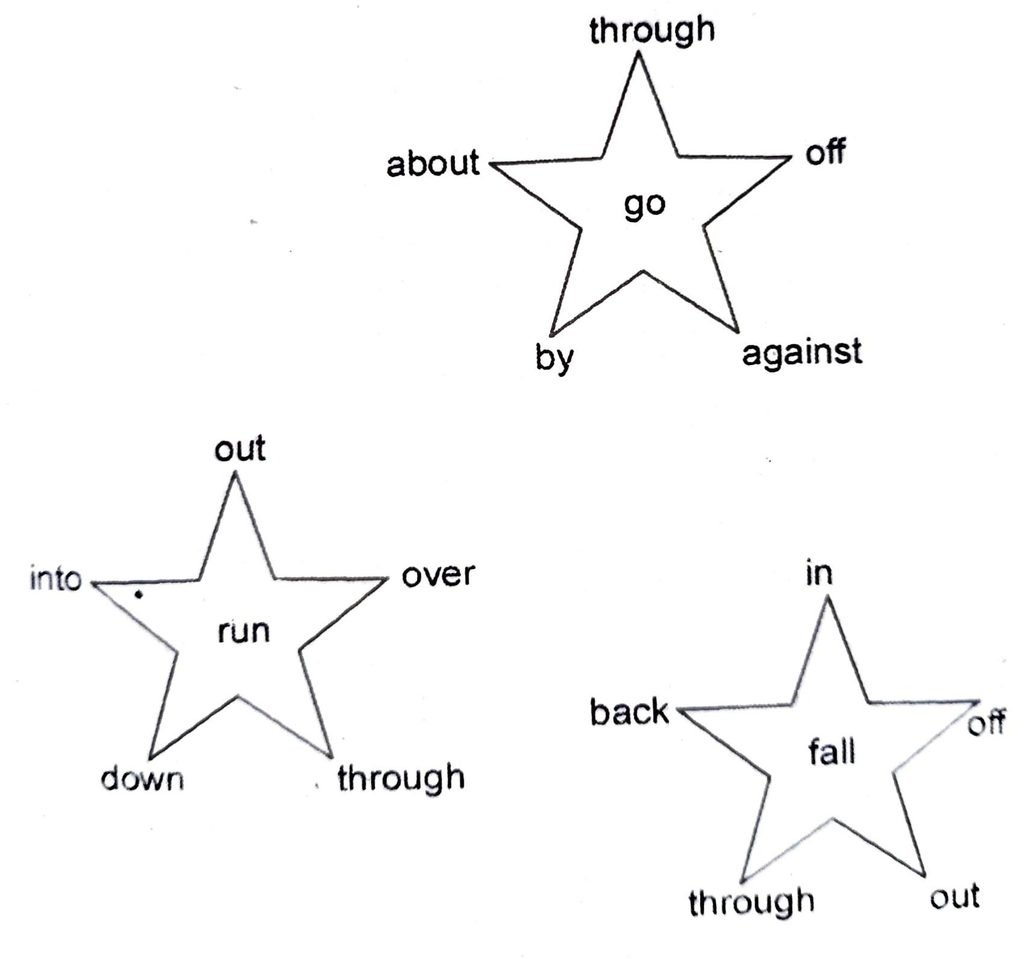
Look up the meanings of these phrases in a dictionary.
go through – to examine in order
go about – to seek
go off – to die
go against – to stand again
go by – to pass near
run out – to finish
run down – too become weak
run into – to go into problem
run over – to cheat quickly
run through – to persue
fall out – to quarrel
fall through – to loose heart
fall back – to recede
fall in – to comply
fall off – to withdraw
Now complete the given sentences with appropriate phrasal verbs choosing from the ones given above.
1. How would I a finding a job?
Ans. go out.
2. We have b of fuel.
Ans. run out of.
3. When friends have a misunderstanding they may c with each other.
Ans. fall out.
4. d the dialogues quickly before you deliver them.
Ans. run through.
5. His plan of going abroad may be because of shortage of funds.
Ans. fall apart.
3.3. LET US LEARN GRAMMAR
Past Tense: In ‘Snakebite’, we learn that:
- We use past tense when we talk about an event that took place at a specific point of time in the past.
- We use the second form of the verb for the past tense.
Choose the appropriate verb from the help box and complete the passage given below, using the simple past tense.
| realise | earn |
| come | start |
| fail | hate |
| try |
Kondiba (a) to Mumbai from Aurangabad to earn his living. He (b) to sell brooms but (c) to earn much. Soon he (d) that blind beggars could earn more. So, he (e) begging, though he (f) it. He (g) Rs.5 to Rs. 6 every day.
Ans. (a) came.
(b) tried.
(c) failed.
(d) realised.
(e) started.
(g) hated.
(h) earned.
Past Perfect Tense
Read the following conversation between Rafi and Neeraj:

Which two actions were completed first and which action took place later?
(a) buying the ticket.
(b) going to the movie.
(c) starting of the movie.
Actions (a) and (c) took place first. Action (b) took place later.
Read the conversation again. You will find that:
(a) In the case of actions/events that were completed first, the past perfect tense (i.e. had + the 3rd form of the verb) is used
(b) In the case of actions/events that were completed later in the past, the simple past tense (i.e the 2nd form of the verb) is used.
Q.1. Identify the sentences with the past perfect tense from units II of the text.
Ans. ______ to find young Arvind who had fallen off a tree trunk
_______ Kondiba had been a good swimmer
_______ once he had been able to dive deep
_______ But it had been many years.
_______ His first dive had given him a good idea of the shape of the well.
Q.2. Use the information given in the chart below. Make as many sentences as you can by combining any two of the sentences at a time. Use the appropriate forms of the verbs (i.e. the simple past tense and the past perfect tense) and linking words when you combine the sentences.
| 6.00 a.m. | Grandmother put on the music |
| 6.30 a.m. | All of us did yoga |
| 7.30 a.m. | Father got us ready for school and mother made the lunch box |
| 8.00 a.m. | My sister and I left for school |
| 9.00 a.m. | Mother enjoyed a cup of tea as she made the monthly budget |
| 2.00 p.m | We returned from school and ate lunch |
| 5.00 p.m. | We went out to play |
| 7.30. p.m | We worked on the school assignments and shared the day’s activities with our parents |
Hint: The sentences that you make will show what happened first and what happened later Do not mention the time.

Ans. 1. Prepared the lunchbox for father after Neena had gone to school.
2. Father left for office after I had prepared a lunchbox for him.
3. I had prepared lunchbox for father before he left for office.
4 Mother washed clothes after father had left for office.
5. We ate lunch after Neena had returned from school.
6. We went out to play after we had attention sap.
7. We worked on school assignments after we had played.
8. We shared the day’s activities with our parents after we had and worked on the school assignments.
Q.3. Use all the words given in each box to make a ‘wh’ question. Do not forget to put Question mark (?) at the end of each sentence.
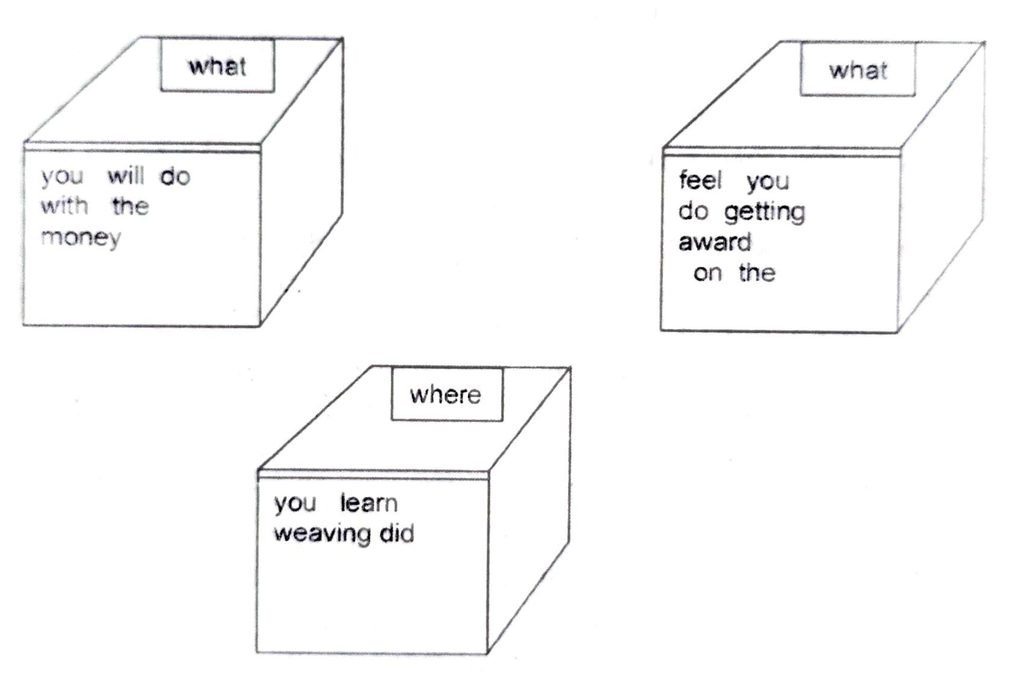
Ans. (a) How do you feel on getting the award?
(b) What will you do with the money?
(c) Where did you learn weaving?
3.4. LET US WRITE
Narrating an Incident: Imagine that one day when you were playing with your friends, you heard the cries of a puppy. The pictures given below describe the incident as it happened. Tell a child or a friend what happened, how it happened, what you did and how you felt afterwards. Now, write, the description of the incident.
Remember to use the past tense and connecting words or phrases.
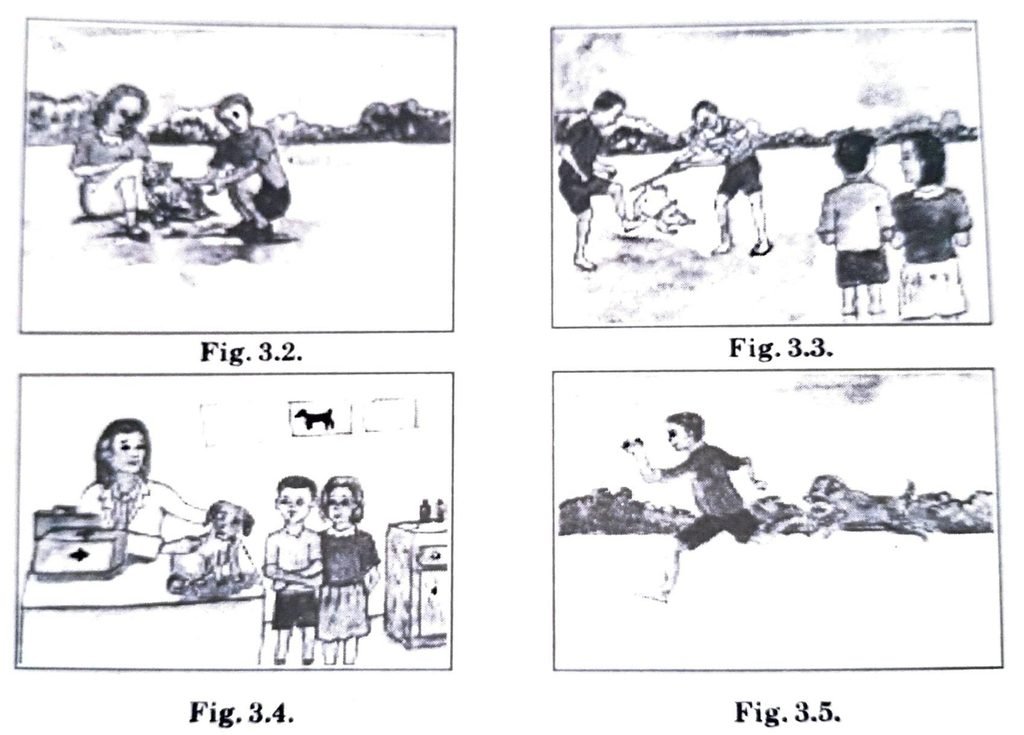
You may begin with ______
One day, when I was playing with ______
You may end with ______
Now, it follows me everywhere.
Ans. One day, when I was playing with a puppy, two boys come. They tried to hurt the puppy When I refused, they hit with stone and ran away. I tried to cure the puppy Next day, I was scolded for being late. Now we have become friends. Puppy puppy follows me every where.
Describing a Person: To write the description of a person, one may choose one or more of the following characteristics. It all depends on the context and the purpose of a description
1. Physical features-built, height, gait, complexion, facial features, forehead, eyes, nose, lips etc., hair, dress.
2. Nature including psychological attributes and values that the person upholds.
3. Habits and expressions.
Consider the following situations. Against, each situation, write which characteristics- physical features, nature including emotional and moral attributes, habits and expressions – you would focus on in your descriptions:
(a) You have arranged a writer for a visually challenged person who is going to take her Board examination. You are telling this writer how he could identify the examinee at the examination centre. _______________.
Ans. The writer will be told that examinee is strong built with a height of around 6 ft. He can also recognise him from broad forehead, long hair and wears kurta.
(b) You are introducing yourself to your new pen friend.______________.
Ans. I am a boy of light built my height is just 55 cm. I always keep army cut and dress up in bright t-shirts of wrangler company on my face would find jovial expressions. Mostly I am polite but sometimes I get aggressive (anger).
(c) You are describing your role model (someone you admire and respect) to your friend._____________.
Ans. My role model is my English teachers Mrs. Suchitra. She is always active, well dressed up and has upto date knowledge. Her way of talking is very friendly, interesting. Her temperament is cool with a sense of belongingness.
Exercise
Q. You have moved to a new neighbourhood. Your next-door neighbour is very jolly and friendly. Write a letter to your friend telling him/her about this
neighbour.
Some of the expressions that you may use are:
smiling face, twinkle in eyes, chirpy, cracks, jokes, friendly, helpful, caring.
Ans. XYZ City
25 Nov, 20XX
Dearest Pulkit
How is your life going on? I am sure you must be missing us. I will be glad to know that Sharmas have shifted in our neighbourhood. They are really a treat to our eyes. Mr Sharma has a smiling face with a twinkle in eyes. We always feel like talking to him. He is friendly and often invites us to his place. My parents feel so secure in their company. When needed he also takes us in his car I wish you were also here to enjoy with us.
Rest all is fine
Give my regards to all yours loving friend Shyam.
DO YOU KNOW
The Persons with Disabilities (Equal Opportunities, Protection of Rights and Full Participation) Act, 1995 holds: the State responsible for the prevention of disabilities, protection of rights, provision of medical care, education, training, employment and rehabilitation, of persons with disabilities.
The Human Rights approach recognises that the talents of children with disabilities need to be optimally developed for the benefit of the whole of society. This approach recognises and emphasises that people with disabilities can accomplish a particular task or perform a particular function, but only in a different manner or taking more time or effort than people without a disability. Hence, the term ‘differently-abled’ is used to refer to disabled or handicapped people.
The following examples show how infrastructure and the inability of able-bodied people to understand the needs of the differently. abled people create problems for them:
- It is the stairs leading into a building that disable the wheelchair user rather than the wheelchair.
- It is defects in the design of everyday equipment that cause difficulties, not the abilities of people using it.
- It is society’s lack of skill in using and accepting alternative ways to communicate that excludes people with communication disabilities.
Read the examples given in the DO YOU KNOW box given above and observe how the infrastructure at public places creates a hindrance for differently-abled people to be independent.
Talk to different people including differently- abled people, and gather various suggestions on how society can reduce these hindrances or difficulties that differently-abled people face in their day-to-day lives. Write at least 5-6 suggestions. You may include your own suggestions also.
For example: Providing audio signals/ instructions at traffic lights can help visually impaired people to cross roads on their own.
Ans. (a) In the buses every stop should be announced so the visually impaired can know where to get down.
(b) At every public place ramps should be there so that wheelchair can easily be used.
(c) The pavements on the roads be such that they are easily accessible for persons with disability.
(d) There should be quite for them to get reservations so that they face no difficulty.
(e) Each differently able should be given free travel viz metro, bus or railways.
LET US LISTEN 3.1.
An interview script with Inspector Ravi Indorkar of the Indore police force is given here. He is creating history by helping the visually impaired students. Ask your friend to read out the script of the interview to you.
Reporter: Inspector Ravi, you have been recording textbooks on cassettes since 1994. How did you get this idea?
Ravi: It so happened that a group of blind people approached me for help in locating an address. When I asked them who they were looking for, they told me that they were going to meet a man, who reads to them from textbooks. Soon I found out that the books in Braille were available only till Class VII. So I decided to record all the books till graduation in all the subjects.
Reporter: How much time do you spend every day to record the books?
Ravi: About a couple of hours.
Reporter: How much do you charge for these cassettes?
Ravi: I circulate them free of cost.
Reporter: How much money do you have to spend every month?
Ravi: Initially I spent my saving in buying a dubbing machine, an ordinary mike and a few cassettes. But soon my colleagues started giving me the cassettes.
Reporter: How did you help these students to write their examination?
Ravi: It was indeed a great problem for them to find writers, who were willing to write in the examination on their behalf. So I appealed to the students of the local schools and created a bank of volunteers of varying age groups. I maintain a register and send the volunteers as writers whenever, the blind students need writers.
Reporter: How do you feel working for a social cause?
Ravi: I am working for my satisfaction and I am still not satisfied. My dream is to take these students to the State Public Service Commission examination.
Reporter: I am sure with your commitment and determination, you would be able to fulfil this dream.
Complete the given questions asked by the reporter:
(a) How did you get this idea?
(b) How much time do you spend every day to record the books?
(c) How much do you charge for these cassettes?
(d) How did you help these students to write their examination?
(e) How do you feel working for a social cause?
LET US TALK 3.1.
Assume that you are a newspaper reporter. To write a report of the incident before Kondiba received the reward, you need to interview Kondiba and Arvind?
What questions would you ask Kondiba after he took Arvind out of the well? What questions would you ask Arvind? Ask them at least two questions each.
Work with a friend. One of you can ask
the question while the other answers.
Ans. Interview of Kondia
Reporter: How are you feeling?
Kondiba: Nothing much.
Reporter: What inspired you to do the act?
Kondiba: My God and inner strength
Reporter: Are you expecting any reward?
Kondiba: Not really
Interview: of Arvind
Reporter: How did you fall into the well?
Arvind: I was playing with the ball.
Reporter: When did you feel you were in danger?
Arvind: When I was caught in the weeds.
Reporter: Did you like Kondiba earlier?
Arvind: Not much.
WHAT YOU HAVE LEARNT
In this lesson, you have learnt that each of us is unique and has different abilities that should be recognized and valued. This also applies to a differently-abled person who is like any other person and has the same kind of feelings and emotions. We should not underestimate the differently-abled people as they too have some special talents and capabilities. They should be treated fairly and as equals as this is their right according to the constitution of India. The State, society and each one of us have a responsibility to help the differently-abled people to achieve their goals and dreams.
You also learnt that if we care for others and keep calm in a difficult situation, usually we can find a positive way out of the situation.
TERMINAL QUESTIONS
Q. 1. Put the following sentences in the correct order to rewrite the story.
First number the sentences. The first one is done for you.
(a) The people of Golibar colony had dug a well in an open area. (2)
Ans. Kondiba was a blind beggar, who lived in Golibar colony.
(b) When Kondiba heard about it, he left his meal and rushed to rescue the boy.(3)
Ans. The people of Golibar colony has dug a well in open area.
(c) Kondiba was a blind beggar, who live in Golibar Colony. (1)
Ans. A boy fell into the well.
(d) A boy fell into the well. (3)
Ans. When Kondiba heard about it, he left his meal and rushed to rescue the boy.
(e) Kondiba became breathless but he did not give up. (6)
Ans. Kondiba dived into the well to bring the boy up
(f) Kondiba’s picture and story were published in the newspaper (10)
Ans. Kondiba became restless but he did not give up.
(g) Kondiba dived into the well to bring the boy out. (5)
Ans. Without thinking about himself he dived again and freed the boy from the weeds.
(h) He saved Arvind’s life. (8)
Ans. He saved Arvind’s life.
(i) Kondiba, a blind beggar, became a hero and was well rewarded. (11)
Ans. Arvind went to Kondiba with his aunt and touched Kondiba’s feet ingratitude.
(j) Kondiba runs a small business and is happy. (12)
Ans. Kondiba’s picture and story were published in the newspaper.
(k) Arvind went to Kondiba with his aunt and touched Kondiba’s feet in gratitude. (9)
Ans. Kondiba, a blind beggar become a hero and was well rewarded.
(l) Without thinking about himself he dived again and freed the boy from the weeds. (7)
Q. 2. Now add linking words/phrases wherever required and write the above story in your notebook. Some linking words/ phrases are given below.
Linking words/phrases:
Thus next day, one day, today, after sometime, next day
Ans. One day, a boy fell into the well.
After sometime Kondiba became breathless, but he did not give up.
Thus, he saved Arvind’s life.
Next day, he went to Kondiba with his aunt and touched Kondiba’s feet.
Today Kondiba run a small business and is
happy.
Q.3. Why do you think Kondiba hated begging?
Ans. He had self respect. He did not like pity which he would get while begging.
Q.4. Kondiba was blind, Yes he became a hero. What qualities of Kondiba helped him change his life and become a hero? Write in about 100 words.
(hint-bravery………………….)
Ans. Kondiba was a blind man of 25. He had saved Arvind’s life. Young Arvind had fallen into the well, Nobody dared to dive into the six metre deep water except Kondiba. It was his brave act which made him try three attempts to find Arvind. His ribs started aching. But he did not give up the habit of the ability to take decision in crisis. When everyone had lost hope Kondiba got into water and pulled Arvind by getting hold of his belt.
Soon word spread of his brave act and many papers published his act. He was given reward of Rs. 12,970 He thus become a hero.
Q.5. After reading the story, what are your views about the abilities of differently-abled people to earn a living? What can you do at an individual level to show them empathy rather than showing pity or indifference?
Ans. Disability people are very hard working and far sighted. They are able to face the situation in a wise manner these people do not need our sympathy but rather they require our support in a spirited manner. I would try to act in a humorous manner and make person the love life.
Conclusion
NIOS Class 10 English Chapter 3 – Kondiba – A Hero teaches us that courage, determination and concern for others can help a person overcome even the most difficult challenges. Kondiba’s bravery in rescuing Arvind shows that physical limitations do not define a person’s abilities or potential. The lesson also encourages us to treat differently-abled people with equality, respect and empathy rather than pity. Overall, this NIOS Class 10 English Chapter 3 is an important lesson for students because it combines an inspiring story with useful language activities and a meaningful message about humanity, courage and self-confidence.