NIOS Class 10 Indian Culture and Heritage Chapter 15 explores the contributions of ancient Indian scientists to mathematics, astronomy, chemistry, medicine and yoga. This chapter covers the achievements of famous scholars such as Aryabhatta, Baudhayan, Bhaskaracharya, Varahamihira, Kanad and Nagarjuna. Students will also learn about ancient Indian medical science, Ayurveda, surgical techniques, Charak Samhita, Sushruta Samhita and the importance of yoga. These NIOS Class 10 Indian Culture and Heritage Chapter 15 solutions include all intext questions and terminal exercise answers to help students understand the chapter and prepare effectively for their examinations.
NIOS Class 10 Indian Culture and Heritage Chapter – 15 Scientists Of Ancient India
TEXTUAL QUESTIONS
Intext Questions 15.1
Q.1. Mention two contributions of Baudhayan in the field of Mathematics.
Ans: (i) First mathematician to calculate the value of pi.
(ii) Derivation of the Theorem that is now called Pythagoras Theorem.
Q.2. Who discovered zero?
Ans: Aryabhatta.
Q.3. What is the importance of Brahma Sputa Siddhantika?
Ans: Arabs came to Know our mathematical system through this book.
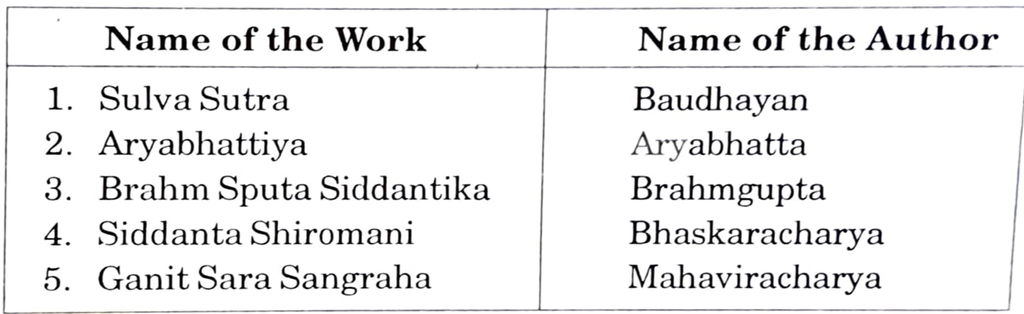
Q.4. Match the following work with their authors:
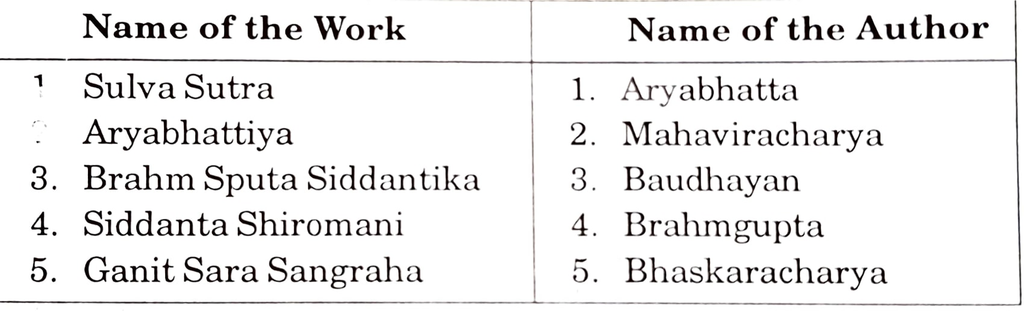
Ans:
INTEXT QUESTIONS 15.2
Q.1. Who was Kanad? How did he get his name?
Ans: A sixth century scientist of Vaisheshika school; even as a child, he was interested in very minute particles called “kana”, so he was named Kanad.
Q.2. Who wrote Brhat Samhita?
Ans: Varahamihira.
Q.3. What was Nagarjuna trying to achieve in life?
Ans: He was trying to transform base elements into gold.
Q.4. What is the subject matter of Nagarjuna’s treatise Rasaratnakara?
Ans: He made an element with gold-like shine; devised methods for the extraction of metals like gold, silver, tin and copper.
INTEXT QUESTIONS 15.3
Q.1. What is Ayurveda?
Ans: Indigenous system of medicine that was developed in ancient India; the science of good health and longevity of life.
Q.2. The oldest book on medicine is ___________.
Ans: Atreya Samhita.
Q.3. Susruta Samhita is a book on ____________.
Ans: Surgery.
Q.4. The father of ancient Indian Medical Science is ____________. He wrote the book called ____________.
Ans: Charak; Charaksamhita.
Q .5. What does Yoga mean?
Ans: ‘Yoking the mind to the inner self after detaching it from the outer subjects of senses’.
TERMINAL EXERCISES
Q.1. What are the theories given by Aryabhattiya in the field of astronomical science?
Ans: Aryabhatta (499 AD): His Aryabhattiya is a concise text containing 121 verses. It keeps separate sections on astronomical definitions, methods of determining the true positions of the plants, descriptions of the movement of the sun and the moon and the calculation of the eclipses.
The reason Aryabhatta gave for eclipse was that the earth was a sphere and rotated on its axis and when its shadows fell on the moon, it cause eclipse.
Q.2. What does Bhaskaracharya’s Siddhanta Shiromani deal with?
Ans: Siddhanta Shiromani dealt with Arithmetic, Algebra, sphere and mathematics of planet.
Q.3. Name the first text book in Arithmetic. Who wrote it? Mention some topics it deals with.
Ans: The first book in Arithmetic was Ganit-sara Sangraha. It was written by Mahaviracharya in 850 AD. It deals with Least Common Multiple, algebraic equations, logarithms etc.
Q.4. Discuss Varahamihira’s contributions to scientific knowledge.
Ans: (i) Varahamihira made great congratulations in the field of hydrology, geology and ecology. He was one of the first scientists who gave list of some animals and plants who could be the indicators of the presence of water underground.
(ii) He gave earthquake cloud theory in Brihat Samhita.
(iii) He also made great congratulations in Jyotish or Astrology.
Q.5. What was Nagarjuna’s contribution to making of imitation jewellery?
Ans: Nagarjuna was a tenth century scientist. The main aim of his experiments was to transform base elements into gold, like the alchemist in the western world. Even though he was not successful in his goal, he succeeded in making an element with gold-like shine. Till date, this technology is used in making imitation jewellery. In his treatise, Rasaratnakara, he has discussed methods for the extraction of metals like gold, silver, tin and copper.
Q.6. Write an essay on Ancient Indian Medical Science.
Ans: Ancient Indian Medical Science:
(i) Atharva Veda: Diseases, cure and medicines were mentioned for the first time in the Atharva Veda. Fever, cough, construction, diarrhoea, dropsy, sore, leprosy and seizure are the diseases mentioned. The diseases are said to be caused by the demons and spirits entering one’s body. The remedies (or cure) recommended were replete with magical charms and spells.
(ii) From 600 BC to 400 A.D.: From 600 BC began the period of rational science in India. Takshila and Varanasi emerged as (two) main centres of medicines and learning. The two important texts in this field are Charak Samhita by Charak and Sushrutsamhita by Sushruta.
(iii) Medicines, Surgery and Contribu-tion of Sushruta:
(a) The plants and herbs used for medical purpose have been mentioned in Charak Samhita.
(b) Surgery came to be mentioned as a separate stream around fourth century AD. Sushruta was a pioneer of this discipline. He considered surgery as “the highest division of the healing arts and least liable to fallacy.” He mentions 121 surgical institutions. Along with this he also mentions the methods of operation, bone setting, cataract and so on.
(c) Plastic Surgery in Ancient India: The surgeons in ancient India were familiar with plastic surgery (repair of noses, ears and lips).
(d) Botany: Sushruta mentions 760 plants. All parts of the plants such as roots, barks, flowers, leaves etc. were used.
(e) Diet to Patient: In ancient Indian stress was laid on diet (e.g. salt free diet for nephrites).
Q.7. Explain the following:
(a) Methods of selecting and preserving dead body in Susruta Samhita.
(b) Hathayoga and Rajayoga.
(c) Tri-Dosa theory of Charak.
(d) Concept of ‘Chitta’ in relation to Yoga.
Ans: (a) Method of selecting and preserving dead body in Sushrut Samhita:
The body required to be preserved should be perfectly cleaned and then preserved in the bark of a tree. The body was then kept in a cage and hidden carefully in a spot in the river. The current of river softened it. After seven days it was removed from river, and cleaned with a brush made fo grass roots, hair and bamboo.
(b) Hathayoga and Rajayoga:
Yoga is physical and mental. Physical yoga is called Hathayoga and mental yoga is called Rajayoga.
(c) Tri-Dosa theory of Charak:
Charak based his treatment on the basis of Three factors in the body named kaph, pit and vayu. Kaph means mucus, pit means bile and vayu means air. Any imbalance in any of the three causes diseases in human beings.
(d) Concept of ‘Chitta’ in relation to Yoga:
Chitta, i.e., dissolving thoughts, emotions and desires of a person’s consciousness achieving a state of equilibrium. It sets into motion the force that purifies and uplifts the consciousness to divine realisation.
Conclusion
Ancient Indian scientists made valuable contributions to mathematics, astronomy, chemistry, medicine and other fields of knowledge. Their discoveries and writings laid an important foundation for the development of scientific knowledge in India. By studying NIOS Class 10 Indian Culture and Heritage Chapter 15, students can understand the achievements of ancient scholars and appreciate India’s rich scientific heritage. These NIOS Class 10 Indian Culture and Heritage Chapter 15 question answers will help students revise key concepts and prepare confidently for their NIOS examinations.