NIOS Class 12 Employability Skills Chapter 17 – Know Your Business Processes helps students understand the basic processes involved in starting and managing a business. This chapter explains important business concepts such as capital, core values, vision and mission statements, goals, objectives and factors of production. Students will also learn about HR policies, recruitment, selection, Corporate Social Responsibility (CSR) and productivity.
Through NIOS Class 12 Employability Skills Chapter 17 Solutions, students can understand the 7Ps of the service marketing mix and the 5S technique of quality management. The answers are presented in simple language to help students understand business operations and prepare effectively for their examinations.
NIOS Class 12 Employability Skills Chapter – 17 Know Your Business Processes
| Module IV: Be Your Own Boss |
INTEXT QUESTIONS 17.1
1. State whether the following statements are true or false.
(i) Capital refers to human resources, which are employed in a business.
Ans: False.
(ii) Core values are the fundamental beliefs of an organization.
Ans: True.
(iii) Mission statement depicts the company’s aspiration for the future position of the company.
Ans: False.
INTEXT QUESTIONS 17.2
1. Fill in the blanks with appropriate words:
(i) Workdays, paydays and pay advances, sick days and personal leave are examples of _______________ Policies.
Ans: HR.
(ii) CSR stands for ________________.
Ans: Corporate Social Responsibility.
(iii) Development is a ______________ concept focused on personality development.
Ans: Broader.
INTEXT QUESTIONS 17.3
1. State whether the following statements are true or false.
(i) USP stands for unique Selling Price.
Ans: False.
(ii) MIS stands for Marketing Information System.
Ans: False.
(iii) Productivity= output/inputs.
Ans: True.
| TERMINAL QUESTIONS |
1. What should be the characteristics of a vision statement?
Ans: Vision of an organization is the big picture of what the company wants to achieve. This is described by one or more statements called vision statements. It outlines what a company wants to be in future. Vision statement makes the beliefs of your organization clear to society, staff and customers.
Vision statement should be:
(i) Easy to communicate – for example, short enough to fit on a T-shirt.
(ii) Easy to understand.
(iii) Shared by your user base.
(iv) Broad enough to include variety of local perspectives.
(v) Inspiring.
(vi) Ambitious.
(vii) Realistic.
2. Differentiate between vision and mission statement.
Ans:
| Vision Statement | Mission Statement |
| Vision of an organization is the big picture of what the company wants to achieve. This is described by one or more statements called vision statements. It outlines what a company wants to be in future. Vision statement makes the beliefs of your organization clear to society, staff and customers. | Mission statement describes what a company wants to do now. It focuses on the present. It defines customer(s), critical processes and informs you about the desired level of performance. A good organization must have a clearly defined mission statement. Mission statements are more concrete and more “action-oriented” than vision statements. |
3. Write any two differences between goals and objectives.
Ans:
| Goals | Objectives |
| Goals are broad primary outcomes that a business wants to achieve. Goals tell us about the ‘whats’ of business. A business may have multiple goals. For example: “We must be a leader and increase our share in the home loan market.” Goals are generally not measurable and only provide a general direction to an organization. | Objectives are measurable and specific. Objectives quantify the thoughts and set a target to achieve its goals. For example, “increase the share in Home Loan segment to 15% by end of 2015 financial year”. |
4. What will be the various factors of production for an oil drilling company?
Ans: The various factors of production for an oil drilling company include land, capital, human resources, and technology.
(i) Raw materials / Land refers to the natural resources used, such as oil reserves beneath the earth’s surface and the physical site where drilling operations take place.
(ii) Capital includes the financial investment required for purchasing machinery, maintaining equipment, and managing daily expenses, as well as fixed assets like drilling rigs, pipelines, storage tanks, and vehicles.
(iii) Human resources are essential, comprising skilled professionals like engineers, geologists, machine operators, safety officers, and other support staff who manage and carry out the operations.
(iv) Technology plays a crucial role in oil exploration and drilling through the use of advanced machinery, seismic mapping software, automation tools, and monitoring systems that ensure efficient and safe extraction.
All these factors must work together efficiently to ensure smooth production and profitability in the oil drilling industry.
5. Briefly explain the selection and recruitment functions of HR.
Ans: (i) Recruitment refers to the overall process of attracting the suitable candidates for available jobs in an organization.
(ii) Selection is the process of choosing the suitable candidate for a vacant job position in an organization. Selection involves testing and interviewing the candidates to evaluate their qualities. Let us understand the difference between recruitment and selection.
6. List 7P’s of service marketing mix.
Ans: 7 P’s refer to the marketing mix for services. These P’s are—
(i) Product: The service or solution offered to meet customer needs.
(ii) Price: The amount customers pay for the service.
(iii) Place: The location or channels through which the service is delivered.
(iv) Promotion: Activities used to inform and attract customers
(v) People: Everyone involved in delivering the service, including employees and customers.
(vi) Process: The systems and procedures used to deliver the service efficiently.
(vii) Physical Evidence: Tangible elements that support the service.
7. Explain briefly 5S technique of quality management.
Ans: The 5S technique is a Japanese workplace organization method that helps improve efficiency, safety, and cleanliness.
It consists of five steps, all starting with the letter ‘S’:
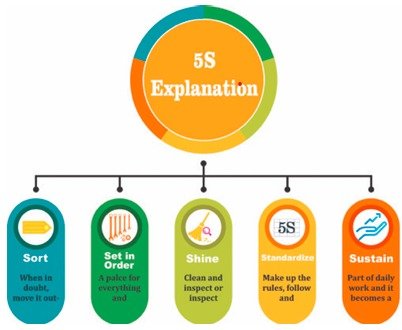
(i) Seiri (Sort): Separate necessary items from unnecessary ones and remove the clutter.
(ii) Seiton (Set in Order): Arrange necessary items in an orderly manner for easy access.
(iii) Seiso (Shine): Clean the workplace regularly to maintain hygiene and prevent defects.
(iv) Seiketsu (Standardize): Establish standards and routines for maintaining the first three S’s.
(v) Shitsuke (Sustain): Develop a habit of following the rules through discipline and continuous practice.
Conclusion
NIOS Class 12 Employability Skills Chapter 17 – Know Your Business Processes provides useful knowledge about how businesses establish their objectives, manage resources and organize different activities. It highlights the importance of vision and mission statements, human resource management, marketing strategies, productivity and workplace quality management. These concepts help students develop a better understanding of business operations.
These NIOS Class 12 Employability Skills Chapter 17 Solutions cover the important intext and terminal questions, helping students revise key concepts and prepare confidently for their examinations.