NIOS Class 12 Economics Chapter 11 – Index Numbers explains the statistical methods used to measure changes in prices, quantities and values over a period of time. This chapter covers the meaning, characteristics and uses of index numbers, along with different methods of calculating them. Students will learn about simple price indexes, simple aggregate index, weighted average of price relatives, Laspeyres index and Paasche index. The chapter also explains the cost of living index and its application in calculating changes in salaries and purchasing power. In this article, NIOS Class 12 Economics Chapter 11 students will find textbook questions and answers, including intext questions and terminal exercise solutions, explained in simple language to support their examination preparation.
NIOS Class 12 Economics Chapter – 11 Index Numbers
Module – IV Statistical Tools
TEXT-BOOK QUESTIONS WITH ANSWERS
INTEXT QUESTIONS 11.1
Q.1. The Paasche Index Number is based on:
(a) Base Year Quantity.
(b) Current Year Quantity.
(c) Average of Base and Current Year Quantity.
(d) none of the above.
Ans. (a) Base Year Quantity.
Q.2. What is an index number?
Ans. An index number is a statistical measure, designed to measure changes in a variable, or group of related variables. Index number is a single ratio (or a percentage) which measures the combined change of several variables between two different times, places or situations. Index number express the relative change in price, quantity or value compared to a base period. It is used to measure change in prices, paid for raw materials, numbers of employees and customers, annual income and profit etc.
Q.3. Write one use of index numbers.
Ans. Index numbers are used in studying trends and tendencies. Since index numbers are most widely used for measuring changes over a period of time, the time series so formed enable us to study the general trend of the phenomenon under study.
Q.4. State any two characteristics of index number.
Ans. (i) Index numbers are expressed in terms of percentage to show the extent of relative change.
(ii) Index numbers measure relative changes. They measure the relative change in the value of a variable or a group of related variables over a period of time or between places.
INTEXT QUESTIONS 11.2
Q.1. From the following data compute an index number by using weighted average or relative method:
| Commodities | Base Year Prices (in ₹) | Current Year Price (in ₹) | Weights (W) |
| A | 100 | 90 | 30 |
| B | 20 | 20 | 15 |
| C | 7 | 60 | 20 |
| D | 20 | 15 | 10 |
| E | 40 | 55 | 25 |
Ans.
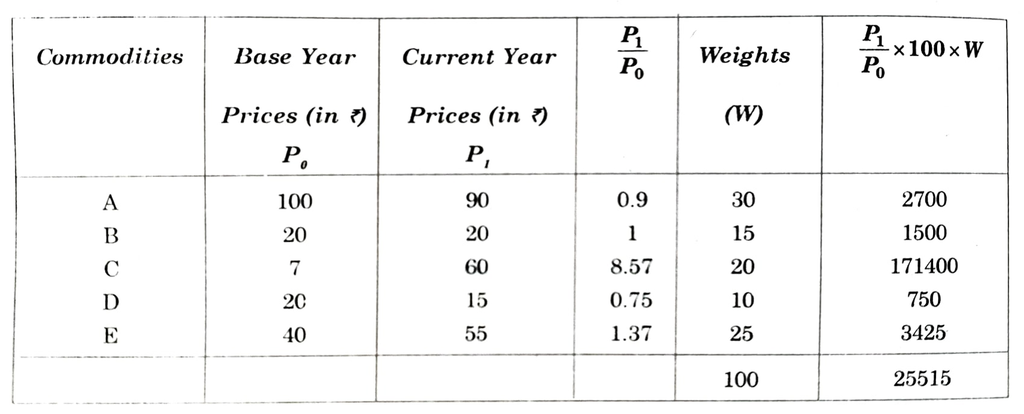
P₀₁ (Weighted Arithmetic Mean)

INTEXT QUESTIONS 11.3
Q.1. Suppose a person was earning 1500 per month in 2005, what should be his salary in 2010, if the cost of living index number in 2010 with base year 2005 is 170.30?
Ans.
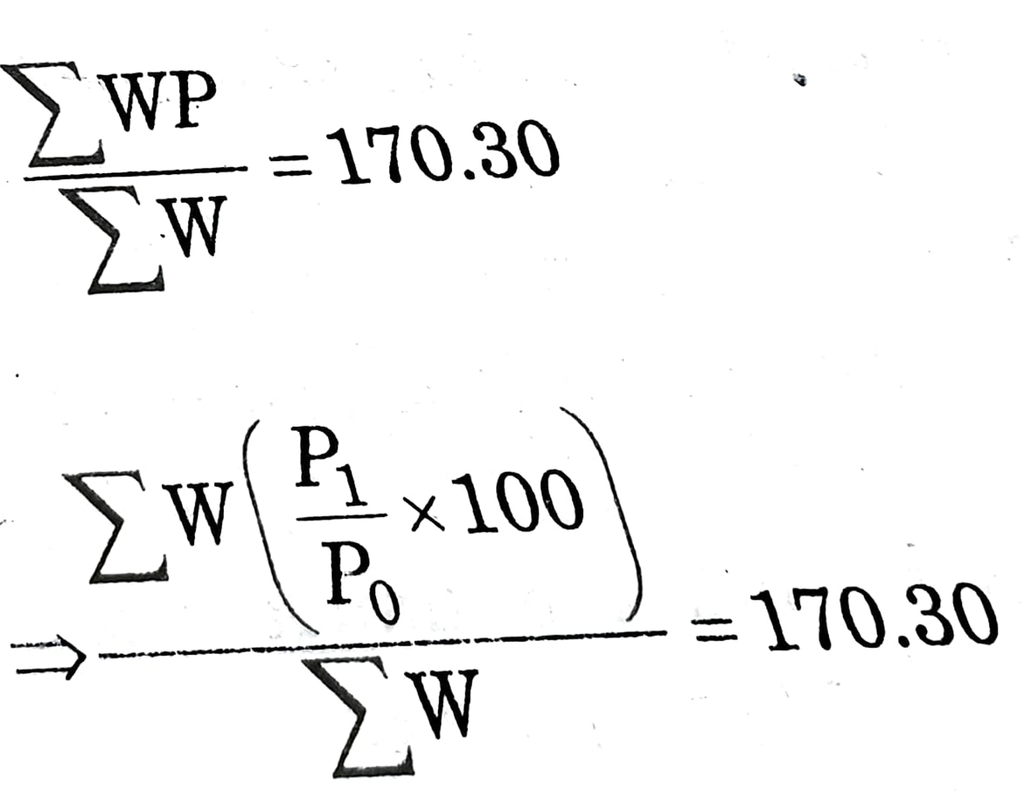
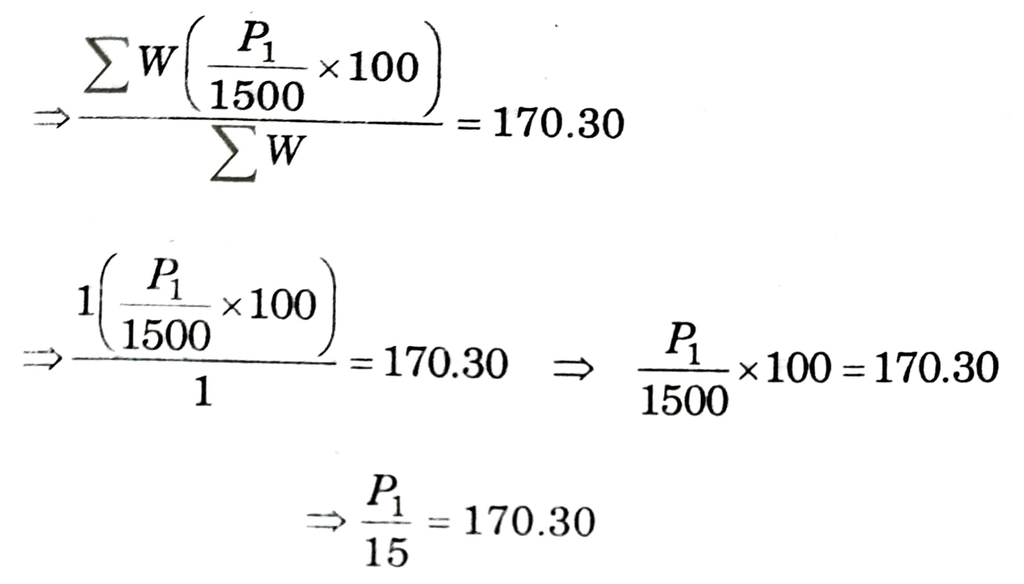
= P₁ = 15 x 170.30 = 2554.5
∴ Salary in 2010 is 2554.5 per month.
TERMINAL EXERCISE
Q.1. Use the following to answer question a-d:
A company buys four products with the following characteristics:

(a) Find the simple price indexes for the products for year 2 using year l as the base year.
Ans.
| Items | Previous year 1 P₀ | Previous year 2 P₁ |
| A | 10 | 11 |
| B | 23 | 25 |
| C | 17 | 17 |
| D | 19 | 20 |
| 69 | 73 |

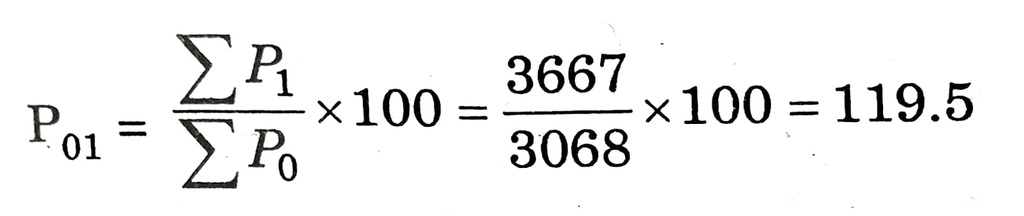
(b) Find the simple aggregate index for year 2 using year I as the base year.
Ans.

(c) Find the base-weighted aggregate index, the Laspeyres index for year 2 using year 1 as the base year.
Ans:
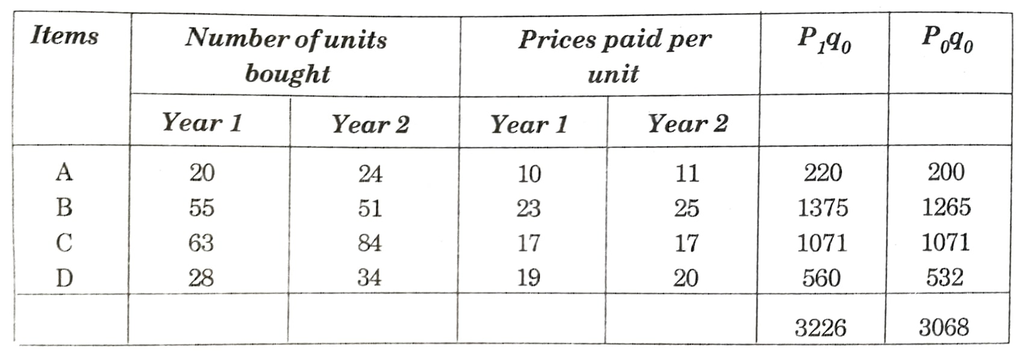
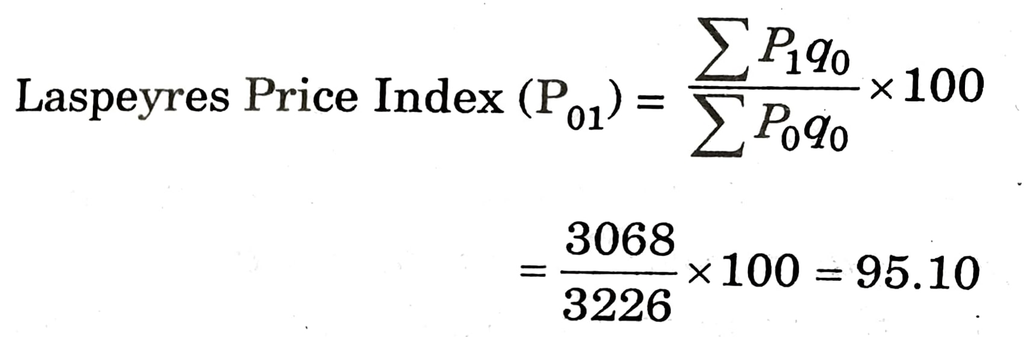
(d) Find the current period-weighted aggregate index, the paasche index, for year 2 using year 1 as the base year.
Ans.


Q.2. During a certain year, Cost of Living Index Number goes up from 110 to 200 and the salary of worker is also raised from 3250 to 5000. Does the worker really gain?
Ans. Number goes up from 110 to 200
∴ 200 – 110/110 x 100 = 81.8% increase in cost of living index.
Percent increase in salary = 5000 – 3250/3250 x 100
= 53.84%
The worker has not gained since the increase in the cost of living index is more than the per unit increase in salary.
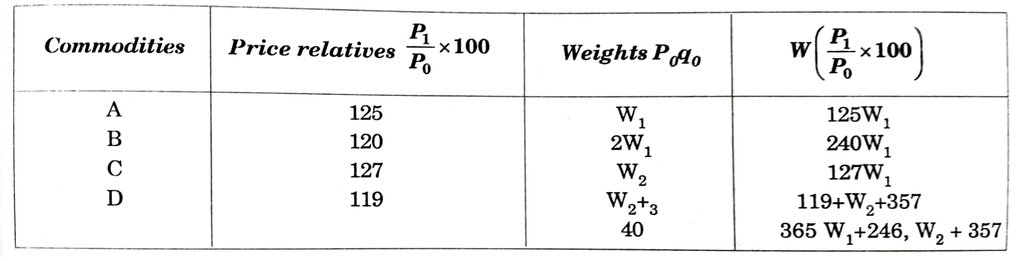
Q.3. The price relatives and weights of the set of commodities are given in the following table:
| Commodities | A | B | C | D |
| Price Relatives | 125 | 120 | 127 | 119 |
| Weights | W1 | 2W1 | W2 | W2+3 |
If the sum of weights is 40 and the index number for the set is 122, find the numerical value of W₁ and W₂
Ans.
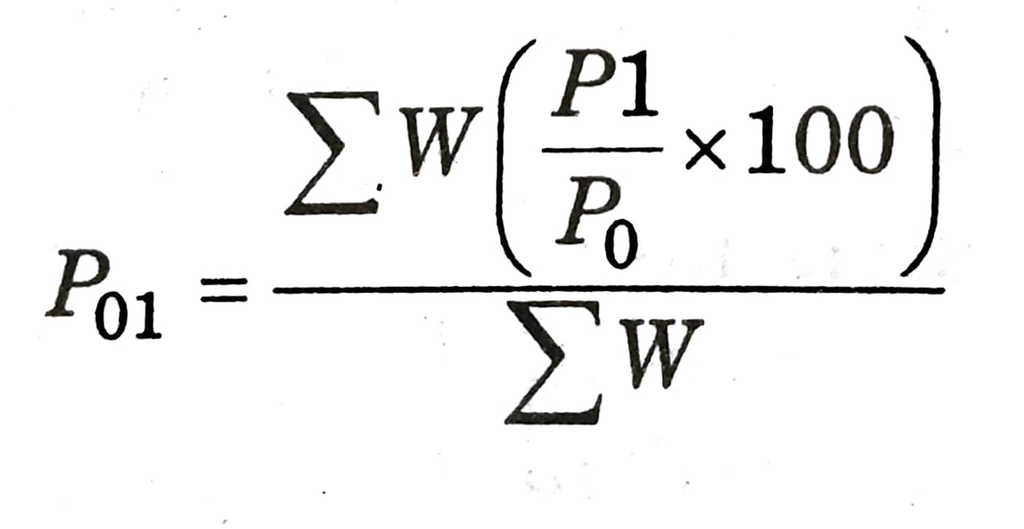
= 365W₁ + 246W₂ + 357/ 40 =122
= 365W₁ + 246 W₂ + 357 = 122 x 40
= 365 W₁ + 246 W₂ = 4880 – 357 = 4523
= 365 W₁ + 246 W₂ = 4523
= 123 (3W₁ + 2W₂) = 4523

Conclusion
We hope these NIOS Class 12 Economics Chapter 11 solutions will help you understand the important concepts and methods of index numbers. By practising the textbook questions and numerical problems, students can improve their understanding of price indexes, weighted averages, Laspeyres index, Paasche index and cost of living index. Regular practice of the formulas and calculations will help students solve numerical questions more confidently. These NIOS Class 12 Economics Chapter 11 question answers will also make revision easier and help you prepare effectively for your NIOS Class 12 Economics examinations.