NIOS Class 10 English Chapter 7 – The Shoeshine is an inspiring story about an educated young man who comes to Delhi in search of a job but faces unemployment and financial difficulties. He decides to work as a shoeshine to earn his livelihood and meets Shovan Lal, who helps him become a member of the Shoeshine Association. In this NIOS Class 10 English Chapter 7, students learn about dignity of labour, kindness, cooperation, unemployment and the importance of respecting every profession. The chapter also includes important questions and answers, vocabulary, grammar, writing activities and terminal questions for exam preparation.
NIOS Class 10 English Chapter – 7 The Shoeshine
BOOK – I
INTEXT QUESTIONS 7.1
Answer these questions in about 30-40 words.
Q.1. Why could the youngman not a afford to buy even a plate of potato chips and a cup of coffee?
Ans. He was unemployed and had just five rupees in pocket.
Q.2. Why did the youngman refuse to get his shoes polished?
Ans. He didn’t have enough money to pay for a cup of coffee and a plate of potato chips. It was not important for him to get shoes polished.
Q.3. Instantly the thought seized me to what thought does the speaker refer to?
Ans. The speaker refers to thought of polishing shoes. It was the thought to work as shoeshine to earn his livelihood.
Q.4. What does the expression ‘he read it’ in this context mean?
Ans. It means that he should understand what he mean.
Q.5. Had you been in such a situation……. ‘no job,’ ‘no money in the pocket.’ What would have been your reaction?
Ans. I would have also been vary disheartened. It is really difficult to live without a job when we have to depend on others for our needs.
Q.6. How much money did the author have in his pocket? Pick out words which help you find the answer?
Ans. The writer had just five rupees. The words which give us the answer are “But the simple fact is that I only here five rupees and some loose change.”
Q.7. There was a puzzled and hurt expression on his face.” Why was the shoeshine puzzled and hurt?
Ans. Shoeshine was puzzled and hurt to know that an educated man should think of polishing shoes. He was hurt at such an idea from an educated man.
Q.8. The shoeshine suggested that the author should get his shoes polished. What reason did he give?
Ans. Shoeshine thought that an unemployed youth can impress the boss with shoes. This would help him get a job.
Q. 9. “But if I can persuade the others” Shovan Lal said, breaking into my thoughts
(i) Who were the ‘others’?
Ans. He is talking about other shoeshine boys working in Connaught Circus.
(ii) What thoughts of the narrator are being hinted?
Ans. To become a shoeshine had become his goal.
LET US LEARN NEXT WORDS 7.1
Q. 1. Find out the difference between unemployment and underemployment.
Ans. Unemployment means a person who is willing to work but cannot find a job. Under- employment means when a person is working below his capacity. He has higher qualification but is working at lower level.
Q. 2. Select suitable phrases from the ones given and complete the following sentences one of them is additional.
make fun of
pull a long face
makes a living
gave another chance
pulled down
(i) (a) Rani’s sister has lost her husband.
She ……….. by giving music lessons.
Ans. makes her living.
(b) We should not ………… people who stammer.
Ans. make fun of.
(ii) (a) Ahmad had broken a glass vase,
when his mother scolded him he ….……. .
Ans. pulled a long face.
(iii) Amit was strong and healthy. Last month he had influenza. He looks ………… now.
Ans. he looks pulled down now.
7.2.2 PART – 2
I walked along the streets …………. Shaval Lal that night.
The narrator wanders on the roads thinking about the City’s glorious past and its sad present state. These paragraphs highlight the problems of shoeshine boys. The narrator is accepted into the union because of his knowledge of English. It would come in handy for their correspondence with the authorities. This section highlights the value of interdependence and empathy.
INTEXT QUESTIONS 7.2
Answer the following questions in about 30-40 words each.
Q. (i) Why did Shovan Lal initially show his reluctance to accept the youngman’s proposal?
Ans. Shovan Lal was not sure if other members of the union would accept youngmen in their group. So he wanted to take their permission
Q. (ii) (a) Why was polishing shoes on the pavement treated like begging?
Ans. It was treated like begging because they didn’t have any proper establishment.
(b) What trouble was the Shoeshine Union having with the authorities?
Ans. The shoeshine union did not get proper recognition. They were refused to be given a licence.
(c) How did Shovan Lal and his friends help the author?
Ans. They collected money to buy the kit for the youngman to start as shoeshine.
(iii) What quality of Shovan Lal’s character is evident in his efforts?
Ans. Shovan Lal shaved deep concern over narrator’s condition. He tried effort to help him in becoming a shoeshine. He had a large heart the made other members of.
(iv) What solutions was offered by Shovan Lal and others to solve the problems?
Ans. It was decided that youngman will help members of shoeshine Association the will get a chance to correspond with authorities in English language.
LET US LEARN NEW WORDS 7.2
Complete the following sentences by using the following phrases appropriately: had come and gone, letting in, taken up, reluctantly agreed, jumped with joy, pay back.
1. When Rita saw her lost puppy in her father’s arms she ……………. .
Ans. 1. Jumped with joy.
2. Mother didn’t want me to spend the night at my friend’s house but when my friend’s mother called her and assured her she ……………… .
Ans. reluctantly.
3. I am awaiting my results but in the meantime I have …………… a temporary job.
Ans. taken up.
4. My friend lent me some money and I promised to …………… by the next month.
Ans. payback.
5. The old man was sitting at the same table in the coffee house since morning many people ……………. but his son did not show up.
Ans. had come and gone.
6. The security at the bank has been tightened. They are not …………. anyone without any ID proof.
Ans. letting it.
7:3 LET US LEARN GRAMMAR
Clauses
1. Read the following sentences
1. Garima told her sister that her classmates were planning to visit the Lotus Temple.
2. My father gave me the book which has been published by NIOS.
3. Gaurav will attend the meeting though
he is unwell these days.
Each sentence can be split in two parts such as
Sentence 1: (i) Garima told her sister.
(ii) that her classmates were planning to visit the Lotus Temple.
Sentence 2: (i) My father gave me the book.
(ii) which has been published by NIOS.
Sentence 3: (i) Gaurav would attend the meeting.
(ii) though he is unwell these days.
Each part is called a clause
Each clause has a subject, verb, and may be with or without an object.
Each clause looks like a sentence. But each clause is not independent.
Each sentence with more than one clause has.
(i) a main (principal) clause. and
(ii) a subordinate clause.
- One of the clauses, though linked, yet is independent. Such a clause is called principal or main clause.
The other clause is a dependent clause
(subordinate)
- It is linked with a subordinate sentence connector (that, which though)
Each subordinate clause has a function to perform. Subordinate clause functions as a noun clause or an adjective clause or an adverb clause.
Let us analyse each sentence.
1. (i) Garima told her sister.
(ii) that her classmates, were planning to visit the Lotus Temple.
2. (i) My father gave me a book.
(ii) which has been published by NIOS.
3. (i) Gaurav will attend the meeting.
(ii) though he is unwell these days.
New look at the following table.

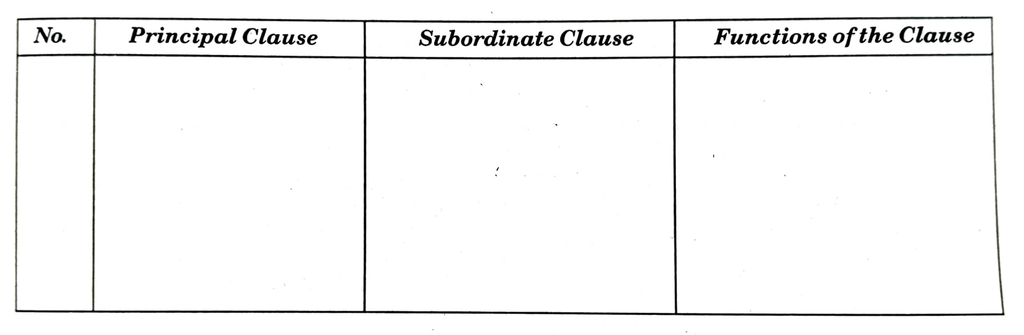
2. Separate the clauses in the given sentences and say whether it is a principal clause or a subordinate clause.
(a) Rajesh informed the visitor that the admission notice has been published in the Hindustan Times dated 8th August.
(b) My friend, who was coming from Mumbai, has postponed his visit.
(c) Yogesh cannot take the final exam because he is unwell.
Ans.

7.4 LET US WRITE
Imagine you are the youngman. Write a letter to your brother back in Kolkata describing your experiences in Delhi.
(i) Based on the text write why the youngman decided to work as a shoeshine Use appropriate sentence connectors.
(ii) Shovan Lal wanted the youngman not to take up the work of a shoeshine. What arguments did he give to dissuade the youngman?
Ans.
Delhi
16 Nov, 20XX
Dearest brother Raghav,
How are you? I am fine here. I know you must be worried about me. You know I come to Delhi with very little money. I had thought I would get a job. But here I could not get one. So, I decided to work as a shoeshine. You will find its funny but believe me there is no way out.
In fact this decision was taken up due to Shovan Lal. He felt very strange. But then I made him understand that no work is low. So, Shovan Lal then decided to help me in every way. I am quite satisfied and will prove my self.
Yours brother
XYZ
WHAT YOU HAVE LEARNT
The story highlights that positive attitude and the ability to think creatively are steps towards achieving success. It emphasises that no work is small, and dignity of about must be respected. Those who earn their living through hard work should be honoured. It also draws our attention towards the fact that everyone is intelligent and if given the opportunity can rise in life.
TERMINAL QUESTIONS
A. Answer the following question in your own words:
Q. 1. How did Shovan Lal react to the youngman’s proposal to start as a shoeshine?
Ans. Shovan Lal was shocked to hear that youngman wanted to become a shoeshine. He was also hurt. It was difficult for him to believe that an educated person would want to polish shoes.
Q. 2. Describe the first meeting of the youngman and Shovan Lal, the Shoeshine boy.
Ans. Shovan Lal wants to get shoes of the youngman polished. The youngman refuses as he can’t afford Shovan Lal is surprised that youngman has only five rupees. Later youngman shows his willingness to work as a shoeshine.
Q.3. What objections did the member of the Shoeshine Association have in accepting the youngman as a member? How far do you agree to their objections? Give reason(s)?
Ans. The other members were not willing to accept at once. They know if another member was included them it would lead to loss of income to all.
Q.4. Had you been in the place of the youngman, what would have been your choice of profession? Give reasons.
Ans. If I had been in place of youngman. I would have taken up a white collared job. I would have taken up any kind of small job.
Q.5. Do you think the youngmen will continue to work as a shoeshine? Give reason for your answer.
Ans. No, the youngman will not continue working as a shoeshine. He will work only till he gets a job as he is educated.
Q.6. Shovan Lal though poor was large hearted. Give at least one example in support of your answer.
Ans. Shovan Lal had very big heart. He was ready to take the youngman to his home.
B. Think and write your answer:
Q.1. The narrator ‘literally jumped with joy’ when he was allowed to become a Shoeshine. What does this mean?
Ans. It means that to become a shoeshine was a matter of great joy. He was in Delhi and had very little money So he needed money for living in a new city.
Q.2. Did the narrator look down upon the work of a shoeshine? Give reasons.
Ans. No, the narrator being educated was very sensible. He respected every kind of profession. He himself offered to be a shoeshine.
Q. 3. It is, what kind of people we are that is more important than the way we earn our living. How is this exemplified in the story?
Ans. In this story we find that shoeshine people earn their living by polishing. But they all have a kind heart and take efforts for the youngman. It is nice to watch them working for a stranger
Q. 4. Imagine you are the youngman. Write a page in your diary recording your reactions to the cooperative gesture of the members of the shoeshine association.
Ans. Dear
Today I am really feeling excited. I had never thought that I would work as a shoeshine. For me coming to Delhi was fill of difficulties. Shovan Lal has opened a new world before me. I am happy that I have decided to be come a shoeshine. I shall work till I get a job.
Sasthi Brata.
Q.5. Write how Shovan Lal had convinced the members of the Shoeshine Association about the rationale behind his suggestion to include the youngman as a shoeshine.
Ans. Shovan Lal is a very kind and considerate boy. He made all the other members of the union to meet youngman Shovan Lal translated all the talks for youngman. Shovan Lal made other members understand that knowledge of English of youngman would help. Youngman would help in correspondence.
Q. 6. Suppose you the young educated man. Your father has come to know about your new profession and is unhappy at your decision. Write a letter to convince your father that your decision was the best option in these circumstances.
Ans. Delhi
Sultan Puri colony
23, Nov, 20XX
Dearest father
Hello, How are you? I am fine and hope you all the same. It’s long since you wrote to me. I know you are very angry at me for taking up profession of shoeshine. I think so you think more of society. By education has taught me work is worship. I have not taken up begging or stealing. I am just going to work and earn money So please don’t me ashamed.
I hope you will understand that no work is low.
Yours son
XYZ
Q.7. Write a paragraph on “Profession of My Choice”
Ans. “Profession of My Choice” choosing profession is very important part of one’s life. Sometimes we are forced to choose a profession due to society or parents pressure. But if we are able to choose profession as per our choice, we will be happy
My choice is to become a doctor. I am working hard for this choice. I know by becoming a doctor. I can work for society. I shall work for poor people and rural areas. I shall never go against ethics of my profession. I hope my aim will be fulfilled.
Conclusion
NIOS Class 10 English Chapter 7 – The Shoeshine gives a meaningful message that no work is small and every person deserves respect for earning a living through honest effort. The story highlights Shovan Lal’s kindness and the young man’s positive attitude during a difficult situation. It teaches students the values of dignity of labour, empathy, cooperation and self-confidence. Through this NIOS Class 10 English Chapter 7, students can also strengthen their vocabulary, grammar and writing skills while preparing effectively for their examination.